Virtual reality: the future of training
27 September 2023
Technology
Technology
Virtual reality is becoming more and more ubiquitous in today's world, finding widespread usage not only in gaming and entertainment, but a variety of other industries too. As the technology progresses and the cost of adoption is driven down, more and more companies are leveraging the flexibility and immersive capabilities of VR training. With each industry having its own unique set of challenges and requirements, how exactly is VR being used to meet them? Read on to learn how some of these industries are implementing VR to train their personnel.
VR simulations can help professionals improve their skills when in-person training is not feasible. In situations where in-person attendance is not possible, such as during the COVID pandemic, VR training offers an alternative, enabling professionals to carry on with their training despite setbacks or locational differences.
As they become more advanced and less expensive and the technology continues to develop, the use cases of VR simulations will increase too. Doctors, for example, can use VR to simulate high-stress situations, such as emergency rooms. This helps them to gain more confidence in their abilities when faced with a difficult situation in real life.
Another benefit of VR simulated environments is their potential to offer students a standardised environment, where students can all learn and practice in the same, uniform way. Gamified elements and performance metrics also contribute to a fun and engaging experience for trainees and allows progress to be accurately tracked. For example, a surgeon practicing their scalpel skills in a virtual environment can be awarded points for successful incisions, and a certain number of points can be set to pass a course.
“The brain learns by increasing connected pathways, immersive learning provides an element of emotional connection that the brain accepts as “real”. With 6 degrees of movement, the brain can’t help but believe what it is seeing is real, and it responds accordingly. This creates perceptual fidelity, activating the same neural pathways as the real activity. This stimulation of the brain invokes real emotional response, which makes learning much more vivid and memorable.” (Deverall, 2023)
VR environments also allow for flexible collaboration, with trainees able to work together even if they are in different locations and practice their communication and team problem-solving skills.

VR can emulate realistic and complex environments where trainees can develop their situational skills, tool proficiency, and process awareness.
Trainees can familiarise themselves in simulations with specific technological components. Many components are hard to get to, buried deep within machines or just hard to access. VR can give trainees an easier time gaining a thorough understanding of important technological components.
VR showrooms can be an effective way to showcase products to people in different locations, saving on traveling costs and the cost of setting up the show room. It can also be useful for showcasing products which have not been manufactured yet.
Similar to the usecase of VR showrooms, VR product demonstrations can offer a quick and easy way to showcase products, both existing and hypothetical.
Designers can use VR for a simple and easy way to collaborate with each other, nullifying the need for designers to travel or be in the same location.
VR training environments can cater to multiple trainees as once, and allow them to train together. Most work environments will require teamwork and collaboration, which makes a collaborative training environment essential.

Mining operations typically encounter difficulties when it comes to planning; mining infrastructure is complex and difficult to design, and because mining sites are often remote, it’s tough for surveyors and planners to access. Design teams are also often based in different countries, making it difficult for them to gain a thorough understanding of mining sites. VR offers an effective and affordable solution to these problems.
The conventional energy industry has several dangers for workers. VR technology can help to train workers and reduce the risk of on-the-job training, where exposure to hazards is greater. Mistakes can be dangerous and expensive, but both can be mitigated through safe VR training.
Specialised training is often required in the renewable energy industry, where personnel need advanced technical skills. This type of training can be expensive for companies to invest in, but VR can help reduce costs, while also helping trainees to avoid potential physical hazards that can go along with the training.
Subsectors throughout the life sciences are adopting VR training technology, due to its potential for more interactive learning, affordability when compared to traditional training, and flexibility when it comes to location. The realistic simulations that VR generates can be useful for training staff on complex equipment and procedures, without the risk of making serious mistakes.
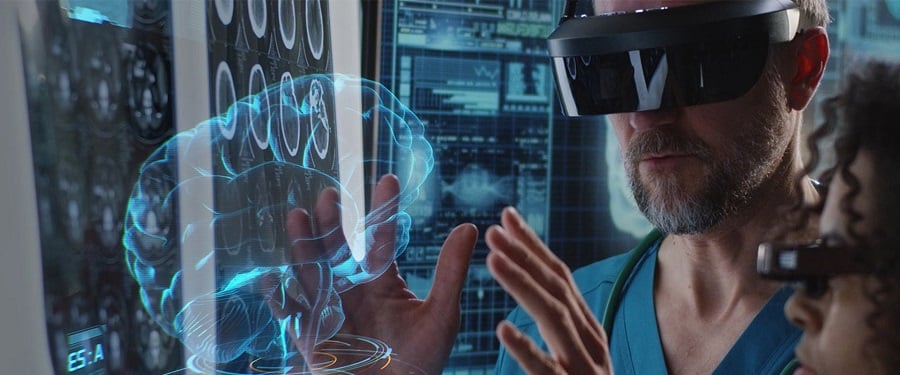
For example, Novartis, a global healthcare company based in Switzerland, uses Oculus VR to allow their researchers to analyse complex 3D molecular information, from which they can develop and test theories for their drug production processes. And Medtronic, a medical technology company, along with startup Surgical Theatre, has developed augmented reality surgical technology to help surgeons visualise the brain during cranial surgery.

While VR training offers a number of advantages, there are still some drawbacks to consider. For example, the upfront costs to get the technology up and running can be expensive, and the costs of maintaining it may be too steep if you only have a small team and training is infrequent.
Some companies may also need specialised features for their training purposes within the VR technology, which can either be expensive or impossible to be developed, in which case they would need to stick with traditional training. What’s more, a common issue with VR training is the ‘screen-door’ effect, where the user equipped with VR goggles sees individual pixels because of the close proximity of the electronic screen, which disrupts the immersive experience and results in ‘virtual fatigue’.

Brunel's technology experts can connect you with the skilled infrastructure, operational technology and connectivity specialists your business needs to thrive.