.png)
Education is key to building a sustainable future. By engaging young people early, we can spark curiosity, nurture talent, and inspire them to explore the industries, technologies, and jobs that will shape tomorrow.
Through our Inspiring Future Professionals focus area, our mission is to open doors, broaden horizons and empower future professionals to see themselves as future innovators, engineers, designers, and problem-solvers. We want every child to have the opportunity to dream big, think green, and discover how they can contribute to a cleaner, more sustainable future.
Renewable energy is an important part of that journey, and hydrogen offers a tangible example of how innovation can support the energy transition. From clean transportation and sustainable industry to energy storage, hydrogen has the potential to play an important role in tackling climate change. By introducing young people to these topics early, we can give them the knowledge, inspiration, and confidence to imagine new solutions and help shape the future

.png%3Fmw%3D1080&w=3840&q=75)

.png%3Fmw%3D1080&w=3840&q=75)
Partnership Living Lab of the Royal NLR

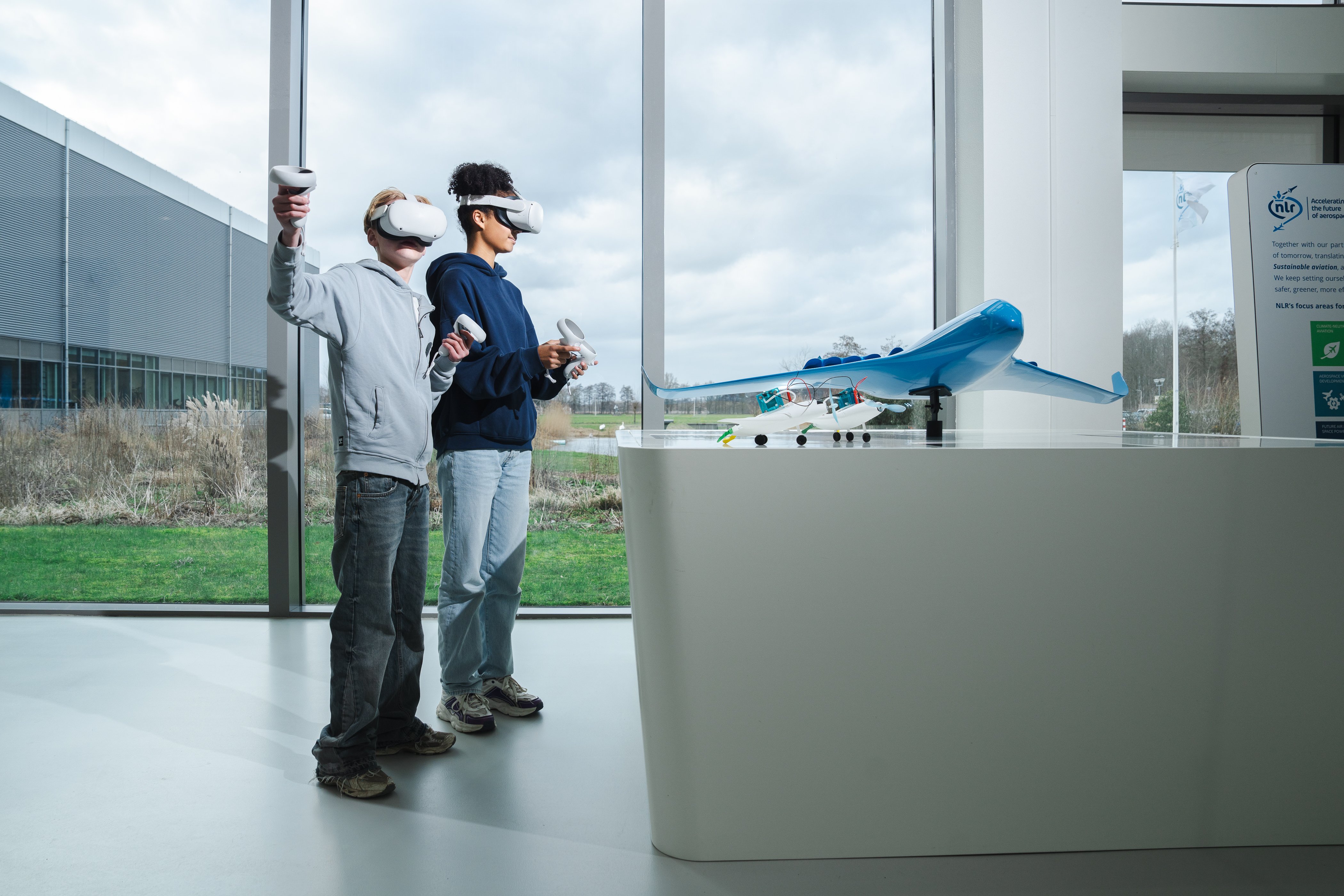
To support this mission the Brunel Foundation developed HydrogenAlpha: a workshop in collaboration with The Living Lab of the Royal Netherlands Aerospace Centre (NLR).
NLR is a leading international research institution for applied research in aviation and aerospace, based in the Netherlands. For over 100 years, NLR has been driven to make aerospace more sustainable, safer, efficient, and effective through innovation. They are a nonprofit and operate independently and objectively, with a focus on multidisciplinary expertise and state-of-the-art research infrastructure across civil aviation, industry, space, and defence.
Within NLR, the Living Lab plays a key role in fostering experimentation, creativity, and cross-domain collaboration. It connects researchers, engineers, external partners, and society, helping translate complex technological developments into tangible, accessible concepts. Through the Living Lab, NLR actively explores new ways of engaging future generations with science, engineering, and sustainable technologies, making it a natural partner for initiatives like the HydrogenAlpha workshop.
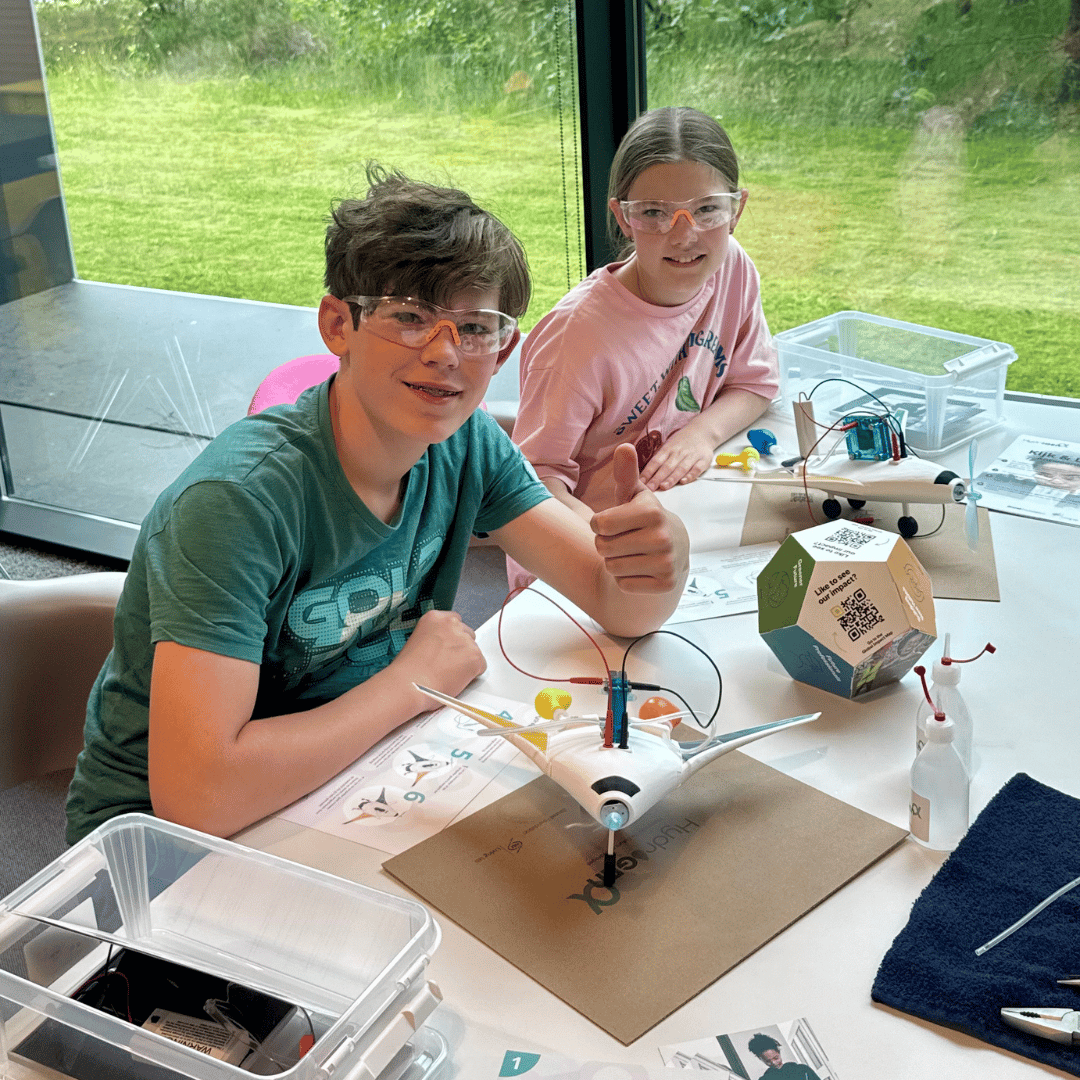
HydrogenAlpha Workshop
HydrogenAlpha is an innovative, hands-on workshop designed to introduce Generation Alpha (and beyond!) to hydrogen engineering and technology in a fun, accessible way. Through short, engaging sessions, the kids:
- Learn the basics of hydrogen
- Discover how green hydrogen is produced
- Experiment with renewable energy in action
What the HydrogenAlpha workshop offers
.png?mw=336)
Fun and Impactful
HydrogenAlpha is designed to make learning about hydrogen fun, practical, and memorable. Participants can produce green hydrogen themselves using a solar panel and see how it powers a hydrogen-driven airplane. This hands-on approach helps bring renewable energy and hydrogen technology to life in an accessible and engaging way.
.png?mw=336)
Workshop kit
The workshop kit contains everything needed to run a complete HydrogenAlpha session, including a 3D-printed airplane, reversible hydrogen fuel cell, solar panel, safety goggles, guidance documents, and supporting materials. Instructions are available in Dutch, English, and German, making the workshop more accessible.
.png?mw=336)
Care for the planet
Sustainability is considered throughout the design of HydrogenAlpha. The airplane has a modular design, allowing individual parts to be replaced rather than the entire model, and it is 3D-printed in a single colour to reduce waste. We are also exploring ways to reuse 3D-printing waste to produce new airplanes.
Ready for take-off?
Four short videos will guide you through the complete HydrogenAlpha workshop.
Building the Airplane
Start by assembling the airplane step by step, producing hydrogen and seeing how it powers the propeller.

Using the Solar Panel
Discover how to replace the battery pack with the solar panel and use sunlight to produce green hydrogen.

Filling the Hydrogen Cell
Learn how to fill the hydrogen cell correctly with distilled water and get it ready to power the airplane propeller.

Storing the Hydrogen Cell
Find out how to store the hydrogen cell properly after use, keeping it in good condition and ready for future use.

FAQ
Congratulations! You have received a HydrogenAlpha kit and started the experiment. Sometimes things don’t go quite as planned, but in 99.9% of cases, the issue is easy to solve. Below you will find some situations that may occur, along with suggested solutions and additional information.
Below you will find some situations that may occur, along with suggested solutions and additional information.
Getting started
There are no batteries included in the workshop kits. Is that correct?
Yes, that is correct. You will need to purchase the batteries yourself and insert them into the battery holders.
There is no solar lamp included with the sets. Is that correct?
Yes, that is correct. If desired, you can order one online yourself. We recommend a lamp with the following specifications:
Brand: Horizon Type: SL3124 Description: Lamp for solar cell 314 Cost: approx. EUR 100
Instructions and/or items are missing. What should I do?
Please send an email to the Brunel Foundation at foundation@brunel.net. The Brunel Foundation will contact you and send the missing items to you as soon as possible.
One of the components is defective. What should I do?
Please send an email to the Brunel Foundation at foundation@brunel.net. The Brunel Foundation will contact you and send replacement parts to you as soon as possible.
I would like to purchase additional workshop kits. Is this possible?
Yes, it is. Please send an email to the Brunel Foundation at foundation@brunel.net.
Hydrogen Fuel Cell
Do I need to fill the hydrogen fuel cell with distilled water before every workshop?
Yes, this is recommended. Refilling the hydrogen fuel cell with distilled water before each workshop will help it perform at its best.
Can I use regular tap water instead?
No, you should only use distilled water. You can order this online or buy it at some drugstores.
Yes, this is recommended. Refilling the hydrogen fuel cell with distilled water before each workshop will help it perform at its best.
Can I use regular tap water instead?
No, you should only use distilled water. You can order this online or buy it at some drugstores.
Filling the hydrogen cell
Do I need to fill the hydrogen cell in a specific way?
Yes. If you do not follow the prescribed procedure, the membrane may be damaged.
How do I fill the hydrogen cell?
- Remove the transparent caps from both sides of the cell.
- Fill the syringe with approximately 1 ml of distilled water and attach a tube to it.
- Keep a piece of paper or tissue nearby, as some water may leak during the process.
- Attach the tube to the lower nozzle on the red O₂ side and gently push the water into the cell. Stop as soon as water starts coming out of the cell.
- Replace the caps on the cell: place one cap on the lower nozzle on the O₂ side and one cap on the H₂ side.
The hydrogen cell is now ready to use.
There is a lot of pressure when I try to fill the hydrogen fuel cell with water. What should I do?
It is best to remove the transparent caps on both sides before injecting the water. Keep a cloth nearby, as the water may come out more quickly once the caps have been removed.
I accidentally filled the hydrogen fuel cell from the wrong side. Is that a problem?
Filling the hydrogen cell incorrectly can damage the cell.
I forgot to put the caps back on the hydrogen fuel cell. What happens then?
You will notice that the balloons do not fill with H₂ and O₂. The H₂ escapes instead of being collected in the balloons. This is not a problem. Simply put the caps back on — one on each side — and the process should work properly again.
Storing the hydrogen cell
How should the hydrogen cell be stored?
Attach both transparent caps to the upper and lower nozzles on the H₂ side. Then place the hydrogen cell back in the plastic bag and seal it.
The hydrogen cell can now be stored safely.
Attach both transparent caps to the upper and lower nozzles on the H₂ side. Then place the hydrogen cell back in the plastic bag and seal it.
The hydrogen cell can now be stored safely.
Balloons Troubleshooting
The balloons are not getting bigger. What could be wrong?
Please check the following:
- Are the transparent caps still attached to both sides of the hydrogen fuel cell? Make sure there is one cap on each side. On each side, one nozzle should remain uncovered.
- Is the switch on the battery holder set to ON?
- Check whether there are any holes in one of the balloons. If you are unsure, use new balloons.
- Did you refill the hydrogen fuel cell with distilled water before starting?
- Are the tubes properly connected to the hydrogen fuel cell?
- Is there a tube connected to both sides of the hydrogen fuel cell?
- Are the elastic bands tightly secured around the balloon and connector so that no hydrogen or oxygen can escape? If you are unsure, use a new elastic band.
- Have you connected both the black and red wires from the battery holder to the hydrogen fuel cell?
- The batteries may no longer be working properly. Replace the batteries in the battery holder. Always remove the batteries from the holder after use.
Battery Holder
Should I always switch the battery holder OFF after use?
Yes. Always set the switch to OFF once the hydrogen has been generated. This will help extend the life of the batteries.
Can I use rechargeable batteries?
Yes, you can. However, first check whether the rechargeable batteries fit properly in the holder. With some brands, the cover may not close correctly.
I have just inserted new batteries, but they already seem to have stopped working. How is this possible?
After using the battery holder, it is best to remove the batteries. Even when the switch is set to OFF, some battery holders may continue to draw a small amount of power from the batteries.
Feedback and Support
I received feedback from participants. What should I do with it?
We are always interested to hear how the HydrogenAlpha workshop is received by both young and older participants. Please feel free to share your experiences and any suggestions that could help make the workshop experience even better.
Send your feedback to foundation@brunel.net.
Do you have any other suggestions for the workshop?
We would love to hear them too!
We are always interested to hear how the HydrogenAlpha workshop is received by both young and older participants. Please feel free to share your experiences and any suggestions that could help make the workshop experience even better.
Send your feedback to foundation@brunel.net.
Do you have any other suggestions for the workshop?
We would love to hear them too!
Get in touch
Email Brunel Foundation
.png?h=1080&iar=0&w=1080)
.png?h=1080&iar=0&w=1080)