Vanadium: key to the green revolution
November 23, 2022
renewable energy
renewable energy
What is vanadium, how is it currently being used and why is there increasing excitement around its role in the future?
To reduce our dependency on fossil fuels and benefit from renewable sources like the sun and wind, we need substantial amounts of finite sources, such as vanadium. Luckily for us, vanadium is the fifth most abundant transition metal in the earth’s crust, and Australia is home to some of the largest deposits in the world.
Though there is growing interest around this versatile metal and the key role it promises to play in the green energy storage revolution, it is a relatively obscure substance which many are not familiar with. Here we break down what it is, how it’s being used and why there is increasing excitement around its role in the future.

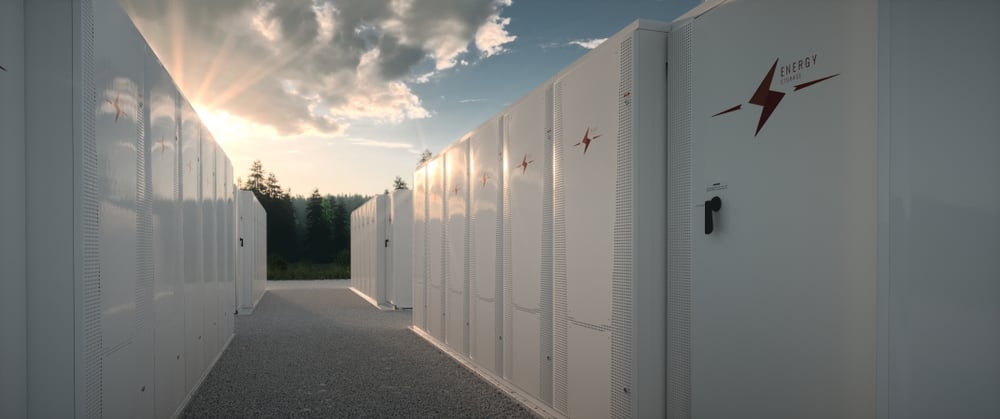
Although vanadium is predominantly used as a steel alloy in today’s market, it has a vast array of other uses, from ‘smart’ windows to cardioverter defibrillators. Perhaps the most buzz-worthy use of vanadium is the role Vanadium Redox Flow Batteries (VRFBs) play in green energy storage. With demand for renewable energy growing at a record pace, the need for utility-scale energy storage has never been more crucial, and impressively vanadium offers a battery material that is 100% reusable.
Vanadium is not exactly a new kid on the block. Discovered in 1801 by Andrés Manuel del Río, the element takes its name from ‘Vanadis’: an old Norse term for the Scandinavian goddess Freyja. Possessing all the strength and mystical allure of its namesake, this silvery grey metal is the sixth strongest metal on earth and is incredibly versatile. Adding less than 1% of vanadium to steel not only doubles the material’s strength, but makes the resulting steel resistant to shock, vibration, and corrosion. When combined with titanium, vanadium creates the best strength-to-weight ratio of any engineered material on earth.
More than 63 million tonnes of vanadium are hiding in plain sight throughout the world today. Not found in its metallic form in nature, it occurs as a trace element in more than 60 minerals, in a range of rock types. Vanadium metal is obtained by reducing vanadium pentoxide with calcium in a pressure vessel.
VRFBs are quite unique in the battery world. They work by taking advantage of the natural properties of vanadium, a metal with four different oxidation states. Rather than using the metal in a solid state, a liquid vanadium electrolyte solution is used for both half-cells, divided by a proton exchange membrane. Vanadium electrolyte is reusable, recyclable, and has a battery lifespan of 25+ years.
What makes VRFBs special is their ability to store large amounts of energy at a ready state for long periods of time, and rapidly release that energy as required. With new sources of green power, how do we ensure communities receive electricity when the wind isn’t blowing and the sun isn’t shining? VRFBs hold the answer, enabling energy output regardless of weather and temperature fluctuations, length of day or unstable grids. VRFBs are non-flammable, can be charged and discharged at the same time, and there is no risk of cross-contamination as only one metal is used. The beauty of vanadium is that it’s infinitely recyclable. Unlike lithium, it is possible to lease it out for use in a battery for a long period and then still recycle it.
Low cost energy storage is going to be very important in the years to come, and VRFBs look to be one of the lowest cost means of storing electricity effectively in a localised fashion. While vanadium itself doesn’t come cheap, batteries using vanadium can be counted on to last for years, due to their recyclable nature.

Australia has a long-running connection to vanadium. The VRFB was invented in 1983 in Sydney by Maria Skyllass-Kazacos, leading to a groundswell of exploration in this space, with more than 20 VRFB companies around the world now developing this technology to a commercial level.
Australia is home to some of the largest reserves of vanadium in the world, sitting on four million metric tonnes. While China currently produces and uses over 60% of the world’s vanadium, Australia is a strong player in the market, with the third largest reserves of vanadium in the world. In fact, North Queensland has enough vanadium to meet the world’s current annual consumption for 120 years. A growing number of exploration projects have been given the green light across Australia, including in Queensland (Julia Creek), Western Australia (Gabanintha), and the Northern Territory (Mount Peake).
On the battery front, Vecco Group announced in April this year that it will construct and operate the first vanadium battery manufacturing plant in Australia. The Debella Vanadium Project plans to produce over 130MWh of vanadium battery electrolyte per annum. Located in South-East Queensland, the battery facility will help make Australia a leader in green energy manufacturing. Australia’s first utility-scale vanadium flow battery is also set to be built in regional South Australia. This $20.3 million project will provide vital support to the South Australian electricity grid which already relies heavily on intermittent renewable energy sources such as the sun and wind.
In April 2021 the Victoria government became the first Australian state to commit to becoming 100 per cent renewable energy powered by 2025. As Australia gets on board with global endeavours to cut greenhouse gas emissions, vanadium – already classed as a critical mineral – is sure to play an increasingly important role in stabilising our energy grid.

More than 80% of vanadium is currently used as an alloy in steel and titanium. In fact, it is the world’s most widely used alloy for strengthening the steel required to construct bridges and buildings. Vanadium-steel alloys are also used to manufacture tools, armour plates, and automobile components such as axles, piston rods and crankshafts.
Far from being all brawn and no brains, vanadium has a wide range of alternate applications. It can be utilised as a pigment in ceramics, as a catalyst in the manufacturing of dyes and printing fabrics, and as an agent of sulphuric acid. Its unique properties have been extracted to produce ‘smart windows’ which lock heat out during summer and retain heat inside during winter, and research is currently underway to use vanadium in the cathodes of batteries for electric vehicles.
In the medical sphere, vanadium has significant effects on cellular growth, redox and signaling processes, as well as enzyme function. Vanadium is used to treat various ailments, from diabetes and heart disease to high cholesterol, and has been used in components of implantable cardioverter defibrillators. Vanadium is in fact essential to humans, although only in very small doses: we need no more than 0.01 milligrams per day.
By 2050, low-carbon technologies will require a higher percentage of the world’s mineral production. Vanadium is listed as one of the top five minerals needed for renewable energy technologies, with demand forecasted to increase by 173% from 2017 production to 2050 requirements. While vanadium remains a steel driven market – a fact that won’t change in 2021 – vanadium battery technology is poised for take-off: with its high efficiency, superior energy density, stable energy output and lengthy lifespan, it holds the key to fully enjoying the benefits of clean energy in the future.