
Harnessing the sun at sea: the promise of offshore floating solar
October 10, 2024
renewable energy
renewable energy
Global energy demand is rising rapidly, with energy consumption set to grow by 50% by 2050, according to the Energy Information Administration. Against this backdrop, there’s not only a pressing need for radical innovation in sustainable energy solutions — but also solutions that use already available technology to combat climate change in new ways.
Solar photovoltaic (PV) power stands as a crucial pillar in this transition. While land-based systems such as solar farms and household solar panelling have long been the focus, a new solution is showing plenty of promise: floating solar.
As part of our “Ask the Pioneer” podcast series, we recently spoke to Don Hoogendorn, CTO of ambitious floating PV company SolarDuck, about the benefits of offshore solar power and how it might transform the world. In this article, we build on his insights to explore why floating solar is fast emerging as a powerful new addition to an increasingly diverse global energy mix.
Rapid urbanisation and economic development, especially in densely populated developing nations, are contributing to the rise in energy demand. But the current energy system still heavily relies on fossil fuels.
Added to this, nearly 20% of the global population still lacks access to basic electricity and other energy sources. As the global economy transitions to one that is largely decarbonised and electrified, there is an urgent need for affordable and sustainable solutions. These solutions must minimise land use as populations grow, while simultaneously maximising access to untapped renewable energy resources.
Traditional land-based solar installations, while absolutely necessary in their own right, may not be able to meet these pressing needs on their own, with challenges such as land costs, land availability, conflicting land use, and environmental concerns all making expansion difficult.
In contrast, offshore locations, which are typically unused spaces, offer both expanses of potential sites and better exposure to sunlight. And by strategically positioning floating platforms near coastal megacities, in combination with offshore wind power, transmission losses and intermittency can be mitigated.
Floating solar farms therefore make for a highly scalable solution. But for them to become as established as land-based solutions, innovative engineering tailored to specific maritime environments will be needed.
Ongoing research from the Australian National University has shown that the most viable regions for installing floating solar are the areas of the ocean that have a low incidence of large waves or strong winds over the past 40 years.
For example, the Indonesia archipelago's approximately 140,000 square km of relatively calm inter-island seas haven’t experienced waves larger than 4m or winds stronger than 10m per second in that time. Offshore solar in this region could generate about 35,000 terawatt-hours (TWh) of energy annually – more than the current total global electricity production of 30,000 TWh per year.
Equatorial West Africa near Nigeria is another ideal location for offshore solar arrays. By establishing floating solar in these and other equatorial regions, up to one million TWh could be generated annually – five times the energy required for a hypothetical fully decarbonised global economy which supports 10 billion affluent people.
And there are other benefits. Water evaporation can be reduced by 28% in the areas where offshore solar panels are installed, owing to their natural cooling effect.
While oceans provide almost limitless space, floating solar panels are also being installed in inland lakes, hydropower dams and reservoirs – another area which has large potential. Research suggests that by installing floating solar on just 10% of the world’s hydropower reservoirs, we could generate the equivalent of today’s fossil fuel power plants. Equally, we’d be capitalising on existing infrastructure, making this a cost-effective solution.
Strategies that revolve around existing infrastructure don’t stop there. In the Netherlands, Don says, solar panels are being placed among wind turbines, sharing existing maritime infrastructure such as cables and substations. This integration promises cost savings by utilising the costly undersea cables laid for wind energy, reducing the necessity for new infrastructure development.
“We just don't have space in the Netherlands,” Don adds. “We have many farmers who want to use the space for different purposes on land. That’s why it's logical for the Dutch government to bring it offshore.”
Pairing solar with wind also enhances grid reliability. In areas like the North Sea, where wind fluctuates seasonally, solar can fill the gap, ensuring a steady energy supply. The Dutch approach sets an ambitious goal, seeking 3 gigawatts of offshore solar by 2030, and the research supports it: the energy per unit area produced by a hybrid concept could be seven times more than a stand-alone offshore wind farm.
There are meticulous engineering considerations that go into designing floating PV panels to achieve reliability, optimisation, robustness, and cost-effectiveness. But as floating solar becomes more viable, challenges remain, including safety concerns, risks associated with electricity-water interactions, standardisation issues, and national policy considerations.
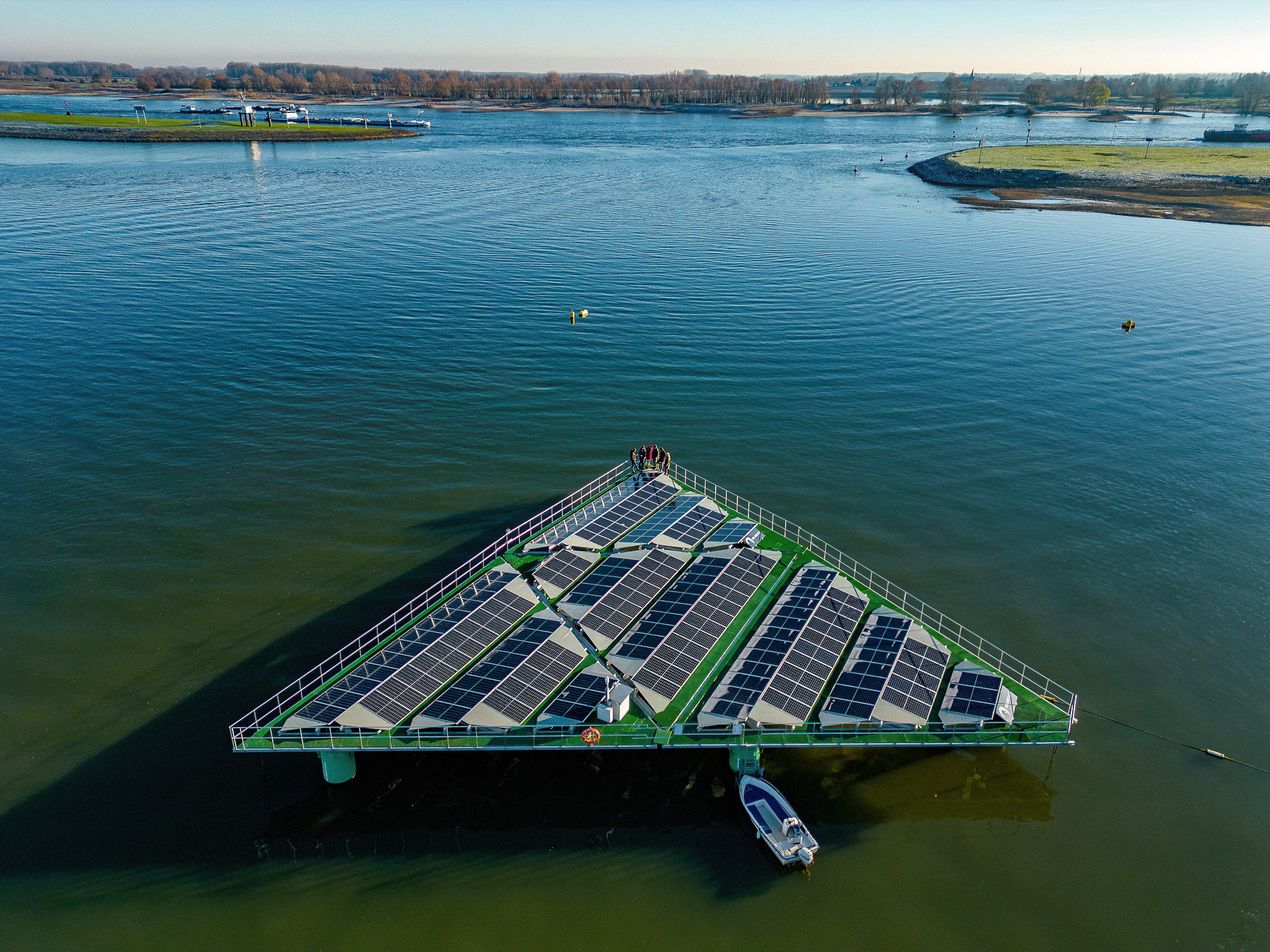
Currently, there are several shapes for offshore floating solar structures, and new designs may emerge in the future. Some of these designs include raft-like platforms commonly used in inland freshwater bodies such as lakes and reservoirs, or rotating platforms that follow the sun’s trajectory. Another shape is the triangular platform used by SolarDuck.
According to Don, the main advantage of this design is that thanks to its three-axis rotation, compared to a square design’s two, structural load is diminished as the platform is allowed to move more freely with waves. It also simplifies connections between platforms, reduces the need for long, buckling-prone couplings. Their elevation above the water lessens drag and shields panels from damaging seawater, allowing use of more affordable solar panels without special seawater-resistant features.
Additionally, the raised structure deters marine growth, which cling to submerged surfaces and necessitate frequent cleaning. By avoiding such growth, energy output is maximized with significantly lower upkeep. These platforms present a compelling solution for offshore solar energy, marrying cost-effectiveness with durability.
As ambitions scale to gigawatt levels, interconnected plants with robust mooring systems will be needed to ensure safety and stability. Offshore deployment also demands robust standardisation – akin to the automotive industry – to minimise maintenance costs.

Besides specific engineering challenges, offshore solar is likely to have an environmental impact. In short, installing floating solar will lead to significant alterations in marine ecosystems. These must be carefully considered via thorough due diligence and hydrostatic analysis.
There are potential impacts on suspended sediments, crucial for light availability in sensitive habitats like seagrass meadows, due to resuspension from construction or maintenance activities. Where floating panels are installed, there will also likely be changes in oxygen levels due to reduced air exchange or altered stratification patterns. Additionally, cleaning and maintaining the floating panels can introduce contaminants, putting marine life at risk.
These installations can impact hydrodynamics, too, thus altering turbulent kinetic energy, wind stress, and heat exchange, which can impact sediment resuspension, nutrient availability, and primary production. The obstruction of air-sea interactions can influence surface temperatures, currents, and stratification, affecting nutrient distribution and primary producer growth. And installations can provide new substrate for benthic organisms, potentially harming local ecosystems.
Nonetheless, there appear to be favourable outcomes linked to the establishment of an artificial reef, facilitating the attachment of mussels and clams to the buoyant floating platforms. The blocking of light caused by the panels can also inhibit the blooming of algae. Algae can harm aquatic ecosystems, and this naturally keeps excessive growth under control.
These are all challenges that will need to be carefully reviewed. While there are gaps in current research, insights from inland floating solar can give us a clearer picture of the
Floating solar technology is advancing quickly thanks to the potential for higher energy yields and efficiency compared to land-based solar systems. This has been borne out in recent studies, which show offshore solar producing 0.6% to 4.4% more energy and 0.1% to 4.45% more efficiency than land-based solar.
Due to this, the business case for offshore solar is gaining traction and several companies have emerged to contribute to a more sustainable future. SolarDuck, founded in Rotterdam in 2019, is one of the companies leading the field in offshore floating solar. Their goal is to deploy over 1 GW annually from 2030 onwards.
“If you want to achieve something big, if you really want to change the world, you should do things on gigawatt scale,” says Don. “
At the rate the industry is expected to improve and expand in the coming years, the elements needed to make that a reality are in play: robust instrumentation, wireless monitoring, and sensing capabilities, as well as tracking systems, bi-facial solar panels, satellite-based optimisation, algorithms for grid integration, and AI integration.
There’s also work being done on offshore floating environments where wave heights exceed 10 metres, with robust protective structures required to withstand these conditions. Innovations include semi-submersible platforms, spar-buoy platforms, tension leg platforms (TLPs), floating production storage and offloading (FPSO) vessels, and floating wind turbines. Each of these systems is designed to ensure resilience against extreme wave heights, and could be applied to solar in due time.
We’re likely to see ongoing advances in mooring techniques, such as streamlined chock designs, which reduce friction and stress points and increase safety.
This increased valuation comes off the back of several notable projects, including a 0.8 megawatt demonstration project from SolarDuck and Tenaga Nasional Berhad (TNB) near Tioan Island, Malaysia, aimed at showcasing offshore floating solar’s capabilities.
But the offshore floating solar industry is still in its earliest stages — development is needed to make the engineering advances necessary to install floating solar in seas where waves larger than 10m occur, for instance. And we’ve already looked at a host of other challenges, such as environmental impact.
So, as the market continues to expand, more research and evaluation is needed to support growth and ensure floating solar energy’s competitiveness.
The development of floating solar represents a significant advancement in renewable energy technology, offering high energy output with huge potential. However, to fully realise this potential, further improvements in the technology are needed, particularly in floating structure design, instrumentation, and monitoring systems.
Addressing challenges such as safety concerns, standardisation issues, environmental impact and policy considerations will be crucial for the widespread adoption of these solar systems. But with continued innovation and technological advancements, floating solar could play a leading role in sustainable global energy production in the decades ahead.