
Training and development at work – The career booster
January 16, 2023
Career and development
Career and development
Finishing your studies and then getting a job and staying in it until you retire is something very few people still experience today. The world of work has grown more dynamic, and many employees deliberately and repeatedly go off in search of new challenges. One important factor in a satisfying career is how you develop and grow individually.
Wanting to grow is part of human nature. That is true of our private life, but also in our job. Anyone just beginning a career will have different goals and ideas to an older colleague. Employers who want to have a well-motivated and hence more productive team should therefore attach considerable importance to staff development. A study conducted by the Haufe Akademie shows that nine out of ten employees never stop learning and developing. The most frequently cited reasons are that they enjoy learning and that they want to develop and improve. In contrast, entrepreneurs claim that only every third employee explicitly wants to develop and improve themselves – despite the fact that, for younger people in particular, this aspect is often crucial to the decision for or against a given job. The Ernst & Young’s 2022 Work Reimagined survey revealed that nearly half (43%) of all respondents are thinking of changing jobs in the upcoming year. The reasons for leaving their current employer include a higher salary and more flexibility elsewhere but in third place, the respondents cite better development options as their main motivation.
The world of work is dynamic. It is always changing. Digitalization repeatedly places new demands on employees, making the buzzword of “lifelong learning” more relevant than ever before: Anyone who fails to regularly develop and improve their skills is in danger of losing touch. Following on from career interruptions such as unemployment, extended parental leave or a sabbatical, people are often required to adapt or build on earlier qualifications before they can return to work. Professional development and training also frequently constitutes the basis for higher salaries and better positions within the company – besides improving people’s chances of finding an attractive new employer when they want to change their job. Aside from these more factual arguments, a raft of soft factors lends further weight to this topic. As well as sharpening their skills, training and development also increases employees’ satisfaction levels, motivation and self-confidence. Learning new things is a good way to guard against monotony and boredom at the workplace. It also broadens one’s horizons – which is something that more and more younger people in particular are specifically looking for. For them, personal development is a critical tool in the search for meaning, self-realization and a fulfilling (working) life.
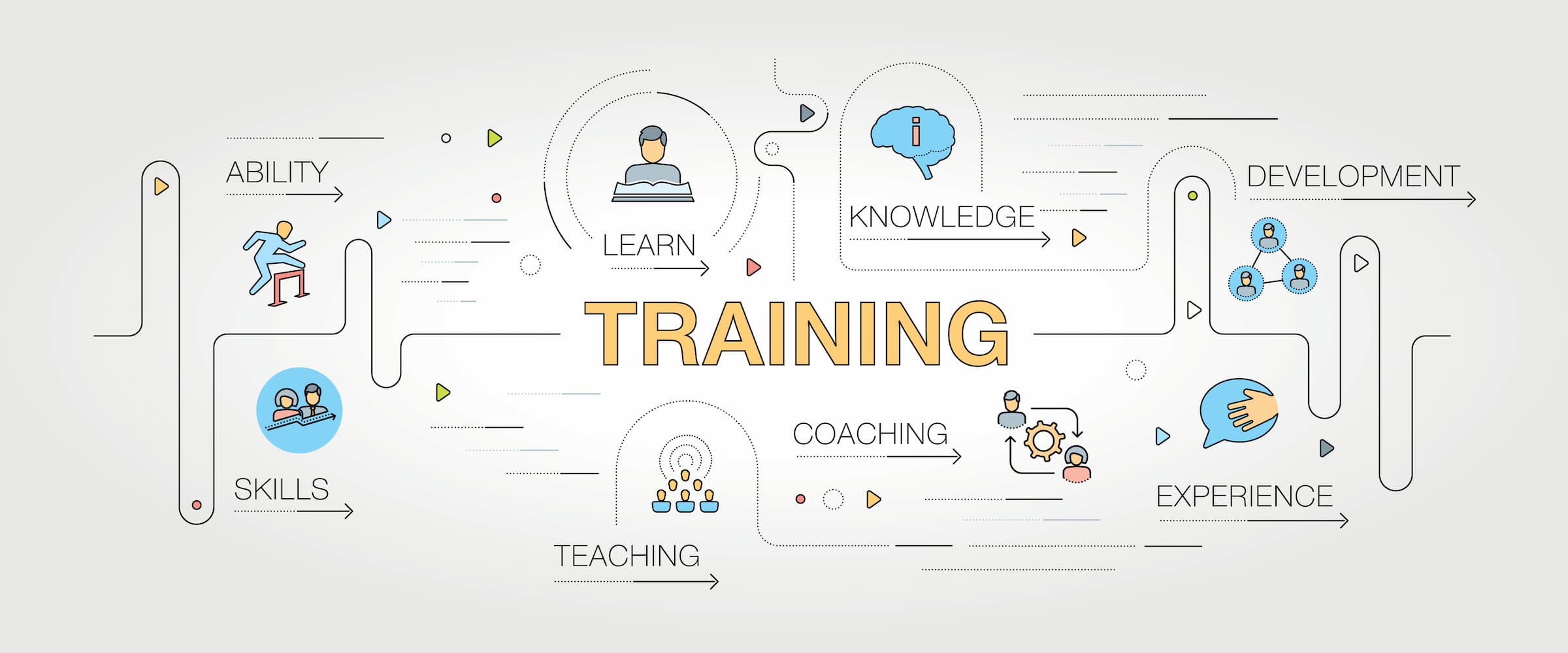
Many companies have responded and now offer their people various options for training and development at the company. One of these is coaching, which, depending on the topic and the objective, can take place individually or in groups. If suitable facilities are available, in-house training too can be provided by external instructors or internal specialists as a good way to develop employees’ capabilities. In the case of on-the-job training, employees are taught new knowledge and new skills by an experienced colleague or manager right at the place of work. In certain areas, skills can also be enhanced selectively by means of internal or external workshops and/or seminars. Some companies have even introduced a job rotation program under which employees swap workplaces and thus get the chance to familiarize themselves with new assignments. Beyond all these options, business games, project work and future workshops can provide fresh stimulus for both the company and the individual employee.
These days, there is practically no line of work in which it is not possible to develop and improve your professional skills. Whether you want to earn specific add-on qualifications for a given profession or enrich your personal skills in people management, time management or communication techniques, the possibilities are many and varied. Especially for people working in technical fields (but by no means only for them), it is almost impossible to keep skill sets up to date without regular training and development. Subject-specific skills are an important criterion to get you a job in the first place and then perform in a way that satisfies both your company and you yourself. But they are not the only factor.
Employers attach just as much importance to the personal and social capabilities – the soft skills – of their employees. Being able to deal with other people is critical to a successful career. In many cases, it is in fact more important than other qualifications. If you cannot work in a team or are unwilling to accept compromises, you will have a hard time climbing the career ladder to the top. Like technical and subject-specific skills, however, soft skills too can be trained and reinforced – through coaching and seminars, for example. But before you do so, it is advisable to take a long, hard look at yourself. If you are willing to invest a little time and patience, critical self-assessment will help you discover which abilities you already possess and which ones still need working on.
If you are keen to actively develop and improve yourself either within or outside the company, it is a good idea to first answer a few questions. Here are some examples:
By no means least, the coronavirus pandemic has given greater visibility to the versatile options afforded by digital learning. This can take the form of online coaching, webinars, podcasts and audio or video courses: Whichever options you choose, mobile devices now make it possible to advance your learning anywhere in the world and at ever shorter intervals. If you are well-organized and highly motivated, you can benefit handsomely from this approach. Moreover, many online learning platforms come with the low-cost advantage, and some are even free of charge. In fact, there are many platforms that offer free online courses, tutorials, and resources. Here are a few examples: