ELT: The biggest eye in the world
November 16, 2020
Career and development
Career and development
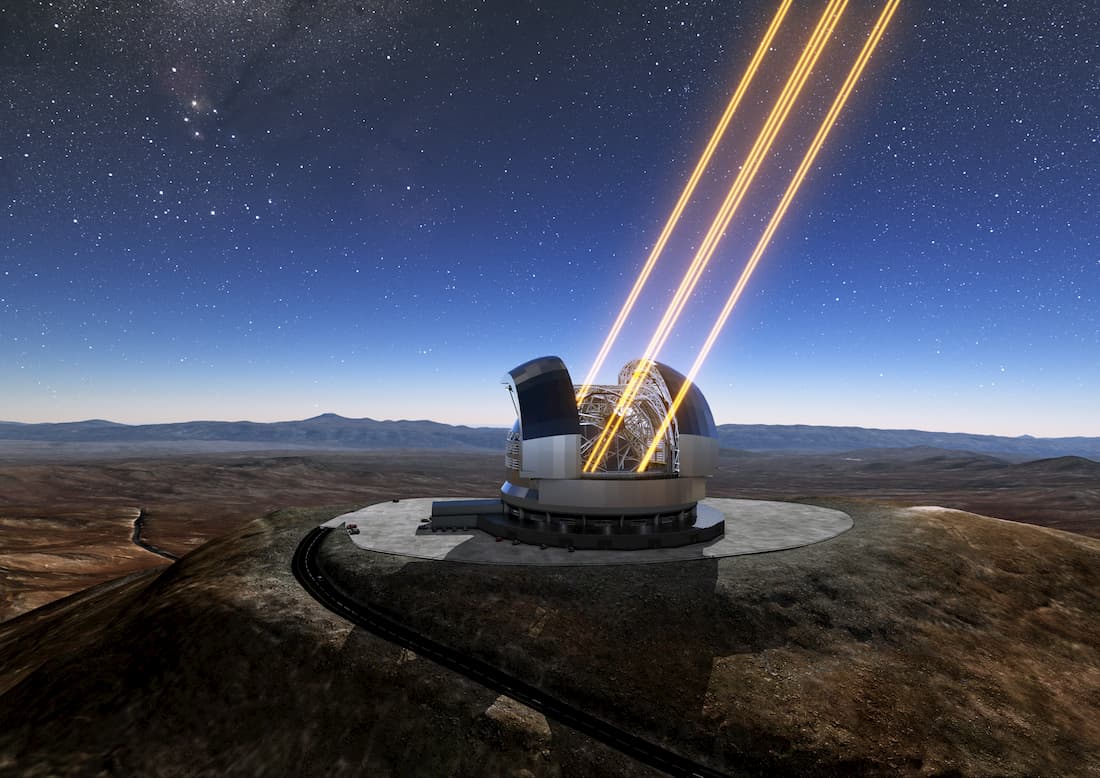
In the Chilean Atacama Desert, a superlative telescope is currently being built that is pushing the limits of technical imagination. The segments of the telescope mirror can be positioned with an error of less than two nanometers - a massive feat of mechanics and control electronics. Brunel employee and embedded software specialist Michael Pangrate was a member of the development team. CollaborationEngineeringjobsFuture

Michael Pangrate (59) studied engineering and computer science in Nuremberg. After graduating as an engineer / technical IT specialist, he worked as a software development engineer for various companies. He has been with Brunel since 2015.
This blog was originally posted by Brunel Germany. See original post here.
Those responsible for the project dare to make a big comparison: "The Extremely Large Telescope (ELT) will revolutionize our perception of the universe, just as Galileo's telescope did 400 years ago". The planned properties of the telescope are impressive and will fundamentally expand astrophysical knowledge: the ELT will collect 100 million times more light than the human eye and 13 times more than any other terrestrial telescope. With this skill, the ELT will be used to search for exoplanets and the first galaxies in the universe, investigate supermassive black holes, and research the nature of dark matter and dark energy.
The ELT is developed by ESO, the European Southern Observatory. It was founded in 1962 by Belgium, Germany, France, the Netherlands and Sweden to give European astronomers access to the southern starry sky. In 2012, ESO decided to build the ELT, which cost around 1.1 billion euros, on the 3,046 m high Cerro Armazones mountain. The ELT is scheduled to start work in 2025 - with a main mirror 39 m in diameter and a light collecting area of 978 m², it will be the world's largest telescope for visible light and near infrared.
The main mirror of the ELT consists of 798 hexagonal elements - each with a diameter of 1.45 m, 5 cm thick and weighing around 250 kg including the bracket. They are made from particularly low-stretch ceramic. Air and light pollution, the greatest enemies of low-lying observatories, are negligible on Cerro Armazones due to its altitude. But wind loads, temperature changes and deformations caused by gravity, which minimally disturb the positions of the mirror segments, also exist here.
In order to correct them, the most advanced active optical system is currently being developed for the ELT, the basic principle of which has been used in earth-based astronomy for almost 30 years: edge sensors that detect relative displacements of the mirror segments in the nanometer range.
Brunel employee and software developer Michael Pangrate explains how the mirror positions are corrected: “A fast processor calculates control signals from the sensor signals in real time, with which the mirror segments are positioned with the help of actuators in such a way that the external disturbances are compensated.” Over 2,000 actuators should align the mirror elements of the ELT so that the mirror surface always retains its optimal shape. This requires 500 positioning movements per second.

Three actuators each precisely connect a hexagonal mirror segment with the support structure of the telescope. The actuators actively control the segment position in all three directions by lifting and tilting in two axes.
The actuators for the positioning system of the ELT's main mirror are developed by Karlsruher Physik Instrumente (PI) GmbH & Co.KG, which was founded in 1970 and with around 1,300 employees is the world's leading specialist in nanometer positioning technology. Michael Pangrate was in PI's electronics team responsible for programming the interpreter, i.e. the communication software that translates the signals from the main mirror control system into instructions for controlling the actuators. His description of the challenge: "With relatively large travel distances of up to 1 cm, our actuators must guide the mirror elements so that their position deviates from the target value by less than 2 nm - with considerable masses to be moved." In addition, the ESO requires the actuators to have a service life of 30 years and a minimal heat emission.
In order to meet these requirements, PI has developed a special hybrid drive consisting of an electromotive spindle drive and a piezo actuator, which combines large travel distances with extremely high positioning accuracy. The spindle can move high loads over long travel distances, but positions relatively imprecisely. In contrast, the piezo actuator, which is stretched or compressed by an electrical voltage, enables high-precision positioning over short travel distances. Both drives are coupled by a high-resolution sensor measuring the inaccuracies of the motor spindle with a resolution of 0.1 nm. Control signals with which the piezo actuator corrects the spindle drive are derived from this data. An above-average service life and high reliability even under adverse environmental conditions are achieved through a specially-developed actuator design: thin piezoelectric ceramic foils are connected to form a multilayer, which is covered by a ceramic insulating layer. In addition, the actuator block is housed in a nitrogen-filled metal capsule.
Three hybrid drives position each mirror segment in the three spatial directions. A main controller generates the individual movement commands for each of the three actuators. Pangrate points out a special feature of the controller: “The task was to develop the transmission protocols and control software in such a way that the interface between the ELT correction signals and the PI hybrid drives is extremely flexible. Subsequent adjustments that become necessary due to changed specifications or further technical developments at the ELT can be implemented very easily."

Continuous coordination in the project team ensures that the control software for the position actuators meets the extreme requirements of the ELT project.
This is exactly where Pangrate was in his element because he was able to bring his many years of experience in the development of embedded systems to the ESO-PI project. “We can only meet the extreme requirements of the ESO because hardware and software are embedded directly in the ELT technology,” emphasizes the Brunel employee. And they have it all: every 2 ms, 2,394 PI actuators will position the ELT mirror surface in real time for years to come with nanometer precision, thus helping the world's largest eye further refine our knowledge of the universe.
Text: Dr. Ralf Cabinet
Copyrights: ESO / L. Calçada (cover picture), ESO (production), picture alliance / Erhard Neubert (Pangrate)
The Extremely Large Telescope (ELT) with its main mirror with a diameter of 39 m is the largest optical telescope in the world. It consists of 798 hexagonal mirror elements and a total mirror surface of 978 m² and thus exceeds all other existing telescopes. The significant differences to other telescopes are therefore the size and the precision of the examinations.

Create the career (and future) you want. Check out our global vacancies today.
Search