Robert Koch: The man who never gave up
July 19, 2023
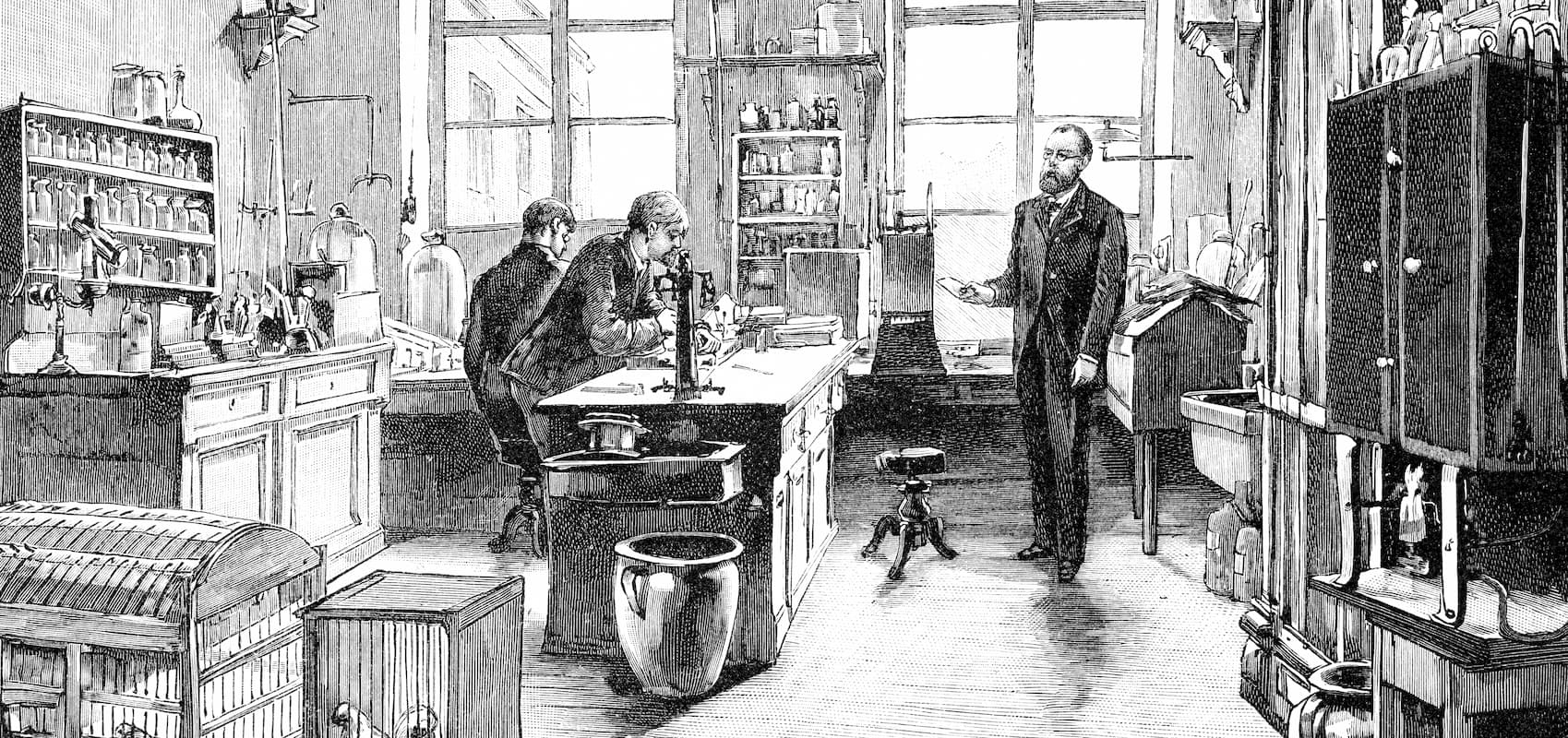
Since spring 2020, his name has been commonplace even to those beyond the realms of science and academia. German physician, epidemiologist and hygienist Robert Koch is seen as a pioneer of microbiology. The institute that bears his name is Germany’s collection point for and source of information, publishing daily updates on the number of cases and the latest insights throughout the coronavirus pandemic.
Could Robert Koch himself ever have imagined a pandemic like this one? Whatever the case, he would undoubtedly have worked just as tirelessly as the staff of the eponymous Robert Koch Institute (RKI) to study and combat it. The secret of his success was simple: “I never give up,” he said, commenting on winning the 1905 Nobel Prize for Medicine for his research into tuberculosis. To this day, his research back then has set the standard in the study of infectious diseases and hygiene. “You don’t have to know who discovered the tuberculosis bacillus,” he once modestly asserted. That said, besides being an inquisitive and tenacious fighter for his cause, Koch was also decidedly ambitious. Born on December 11, 1843, the third of 13 children of a mining official, Koch began collecting and cataloguing various plants even as a boy. After earning his Abitur (German high school degree) at the classical grammar school in his native Clausthal, he went on to study medicine in Göttingen. He worked as a hospital doctor in Hamburg, near Hanover and in Potsdam before the outbreak of the Franco-Prussian War in 1870. He volunteered for service as a medical orderly and, at a field hospital, mainly treated soldiers suffering from dysentery and typhoid – both of which were serious bacterial diarrhoeal diseases, often with fatal outcomes. At the end of his military service, he completed his exams to become a public health officer at the municipal hospital in the province of Poznan in 1872. Alongside this ‘day job’, he also served as a court-certified expert and ran a private practice to treat the poor and needy.

1854: Robert Koch (top row, left next to the mother) with his family in Clausthal in the Harz region. Much earlier, at the age of five, he astounded his parents by teaching himself to read using the newspaper. Early indications of his perseverance and determination. © RKI
Despite so many practical demands on his time, Robert Koch maintained a keen interest in research, conducting experiments in the small, primitively equipped laboratory he had set up in the house where he lived. He was supported by his wife Emmy, a medical technical assistant. Consistently logical structures and meticulous precision were the hallmark of the couple’s experiments. And for good reason: At the time, the epizootic (animal) disease anthrax not only drove many a farmer in the region to rack and ruin, but repeatedly also afflicted humans. Koch identified rod-shaped entities in the animals’ blood as pathogens that form resilient spores. He successfully isolated them and proved his theory by using them to make healthy animals sick. Koch was a huge fan of microscopes made by Carl Zeiss, a pioneer in the optics industry. Once, when placing an order with Zeiss for a microphotographic device, he wrote: “I have succeeded in impregnating the bacteria with dyes that do not change their form and make them visible with exceptional clarity.” Koch became the first bacteriologist of his day to deduce why a pathogen can resist various environmental factors and what conditions must be met to cause an infection. His key insight? “The bacterium is nothing; the milieu is everything.” In other words, bacteria cannot affect a healthy immune system, but disease occurs when this system is weakened.

Robert Koch in 1896 on an expedition in Egypt with his second wife Hedwig. © Archiv der HU zu Berlin/RKI

In 1906, while searching for the causative agent of sleeping sickness, Koch (on the right) dissects a crocodile on the Sese Islands in Lake Victoria, Africa. © RKI
.jpg%3Fmw%3D1080&w=1920&q=75)
Robert Koch at his desk. © Alamy Stock Photo/Granger- Historical Picture Archive
Published in 1876, this ground-breaking research was the reason why Robert Koch was summoned to the Imperial Public Health Authority in Berlin, where, as of 1880, he stepped up his bacteriological methodology for studying infectious diseases and developing countermeasures such as disinfection procedures. After publishing a paper on bacterial cultures, he presented his findings regarding the pathogen behind tuberculosis – at the time a widespread and seemingly invincible disease – to the Physiological Society in Berlin in 1882. Koch’s understudy Paul Ehrlich, after whom the Federal Institute for Vaccines and Biomedicines was subsequently named, later described “vivid memories” of this lecture as “the greatest scientific experience” of his life.
There was now no stopping Robert Koch’s stellar rise to global fame. His techniques, methods and criteria for proving the existence of pathogens set the trend. In 1883/84, he gleaned important insights into the cholera pathogen on a British government expedition to India. On his return, Koch was celebrated in Germany as a hero and rewarded with the newly created Chair of Hygiene at the University of Berlin. Shortly afterward, the Frenchman Louis Pasteur – the other founder of microbiology, alongside Koch himself – discovered the rabies pathogen and launched an economically successful immune serum. Koch’s own zeal was piqued: He desperately wanted to unveil a remedy for tuberculosis, and what became known as tuberculin initially caused a euphoric sensation in 1890. Deaths occurred during treatment with the supposed miracle drug, however, and Koch was forced to disclose the formula: In the substance, he had merely processed extracts from tuberculosis pathogens but was unable to furnish evidence of their effectiveness – contrary to research rules he himself had originally devised, although they were not yet established as a common standard. (A Medicines Act was not passed in Germany until 1961.) Despite this scandal, and in light of his otherwise revolutionary insights, Koch was soon appointed as Director of the Royal Prussian Institute of Infectious Diseases, which had been created specially for him. He led the institute for 13 years. It was one of the first biomedical research institutes in the world, handling contract work and producing expert reports on both a national and an international level.

Robert Koch's hand-drawn illustration of an anthrax pathogen from 1876. For his microscopic studies, he developed the technique of the hanging drop, in which the microbes are cultured in a droplet on the underside of a microscope slide. © RKI
From the mid-1890s onwards, Koch undertook frequent field trips to investigate tropical diseases (such as malaria) and animal diseases. In so doing, he consolidated his reputation as an expert and was ultimately awarded the coveted Nobel Prize in 1905 for the basic research into tuberculosis that he had continued even in the wake of the scandal. When he died in 1910, his ashes were interred in a specially built mausoleum at the institute. Two years later, the institute was renamed the Robert Koch Royal Prussian Institute for Infectious Diseases, a moniker abbreviated in 1942 to its present name: the Robert Koch Institute. A ‘monument’ was thus erected to the name of the passionate biomedical researcher who never gave up.