From machines to AI – Ten facts about robots
February 15, 2023
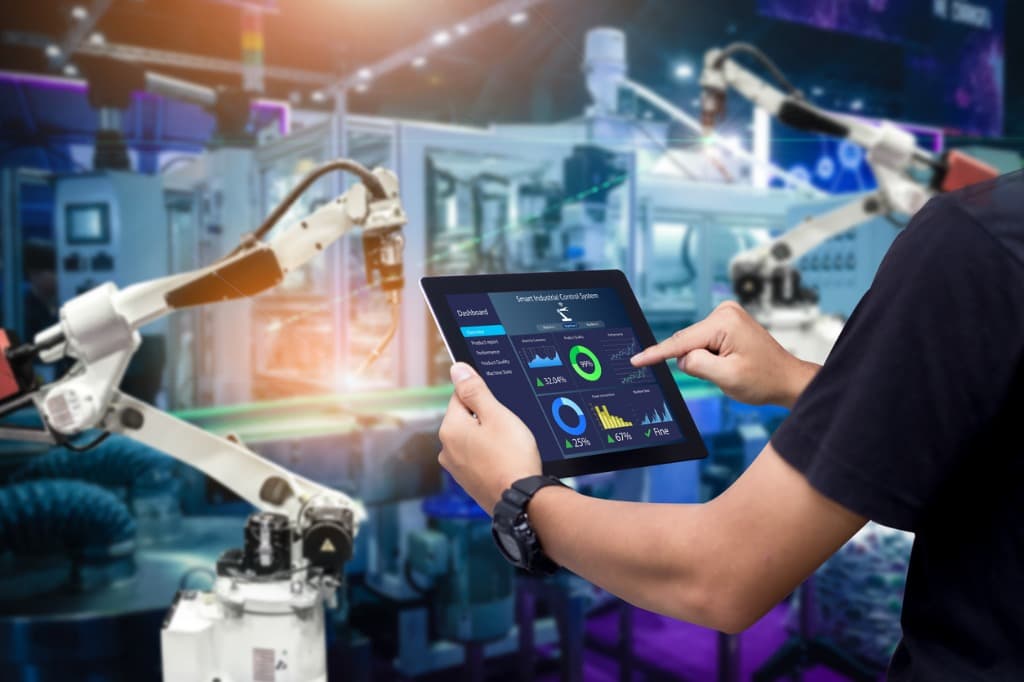
Only a few decades ago, robots – programmable machines – were nothing more than protagonists in science fiction films. Today, everyday life would be inconceivable without them. In automotive engineering, at home, in the operating theatre, wherever: Artificial intelligence already complements human labour in many areas. But where does robotics have its roots? When was the term first used? And what new developments can we expect in the years ahead? Read on to discover ten fascinating facts about robotics.
The term “robot” derives from the Czech word “robota”, which translates into “front duty” or “forced labour”. Today it is used for programmable machines which can complete human tasks quickly and easily. The word was used for the first time in Rossul’s Universal Robots (R.U.R.), a 1920s play by Czech writer Karel Čapek. In his drama, the robots overthrow their human creator.
As far back as 1495, Italian polymath Leonardo da Vinci drew up detailed plans for a mechanical knight based on the structure of the human body. With the aid of a pulley, the knight was able to sit down, stand up, raise its visor and move its chin, neck and arms. In 2002, robotics specialist Mark Rosheim took da Vinci’s knight as his template and developed a prototype that could speak and wave. Later, these drafts served as the inspiration for robots which he would build for NASA.
A robot whose appearance and behaviour are similar to those of a human is referred to as an android, a humanoid robot. One of the most famous examples from the annals of science fiction is Lieutenant Commander Data from the Star Trek series Starship Enterprise – The Next Century. Perhaps somewhat less well known is “Repliee Q1”, an android with the appearance of a 35-year-old woman developed in 2003 by Japanese scientist Hiroshi Ishiguro.
The “Three Laws of Robotics” were first formulated by Isaac Asimov in his 1942 short story Runaround. According to these laws, a robot (1) may not injure a human being or, through inaction, allow a human being to come to harm; (2) must obey the orders given by human beings except where such orders would conflict with the first law; and (3) must protect its own existence as long as such protection does not conflict with the first or second law. These laws are referenced almost exclusively in films, however: Separate safety regulations apply for industrial and domestic robots and for robots with military applications.
American physicist Joseph Engelberger is regarded as the father of robotics. Together with George Devol, he founded Unimation – the world’s first robot production firm – in 1961. “Unimate” became the first industrial robot and was deployed by Ford to weld die-cast parts for car bodies on its production line.
Service robots is the term used to designate robots that provide services to humans. They fetch and bring objects, supply information and navigate or monitor their owners’ environment. Especially in Japan, domestic helpers such as “Pepper” are in widespread use. Pepper is the first humanoid robot programmed to analyse human emotions on the basis of gestures and facial expressions and to respond accordingly. In Europe, robotic vacuum cleaners and lawn mowers are still the predominant models deployed in the service robot category.
Nanorobots are a billion times smaller than a grain of salt. These minuscule robots comprise various atoms and will, it is hoped, completely revolutionize healthcare. They search the body for cancerous cells and then cut off the supply of blood to these cells. Initial tests have already proven the effectiveness of this concept.
Trials with social robots have long been underway in the context of care for the elderly. “Rosie”, for example, is a robotic seal which weighs three kilogrammes and is 50 centimetres long. Sensors and artificial intelligence allow Rosie to simulate a live baby seal. Its developer, Takanori Shibata, asserts that this therapeutic Paro robot in the Paro model series can help brighten the mood of elderly care patients – especially dementia sufferers – and children on the autism spectrum. Its purpose is to alleviate fear and pain, improve the quality of sleep and attenuate feelings of loneliness. More than 4,000 Paro seals are in service around the world.
Whether they are used for bonding, welding or grouting, industrial robots are accurate to within a millimetre. To enable the robotic controller to see where the bonding or welding head is currently positioned, the machine needs a kind of eye. Until recently, however, the flexibility of available sensors was limited by shadowing effects: If the direction of motion changed, the eye remained ‘blind’. The Fraunhofer Research Institution for Additive Manufacturing Technologies (IAPT) has found a solution to this problem: Its patent-protected SensePRO laser sensor features a specially developed analytical sensor technology that creates a shadow-free all-round field of view, which translates into complete freedom in any direction of travel.
South Korea has 932 industrial robots for every 10,000 employees, making it the world leader. It is followed by Singapore in second place, with 831, and Japan in third place, with 390. According to the International Federation of Robotics (IFR), more than three million industrial robots are currently deployed in factories around the globe. New robots worth 13.2 billion US dollars were installed in 2020 alone.