What Asia's Flagship Offshore Wind Projects Tell Us About Delivery Realities, Risks, and Capabilities
10 April 2026
renewable energy
renewable energy
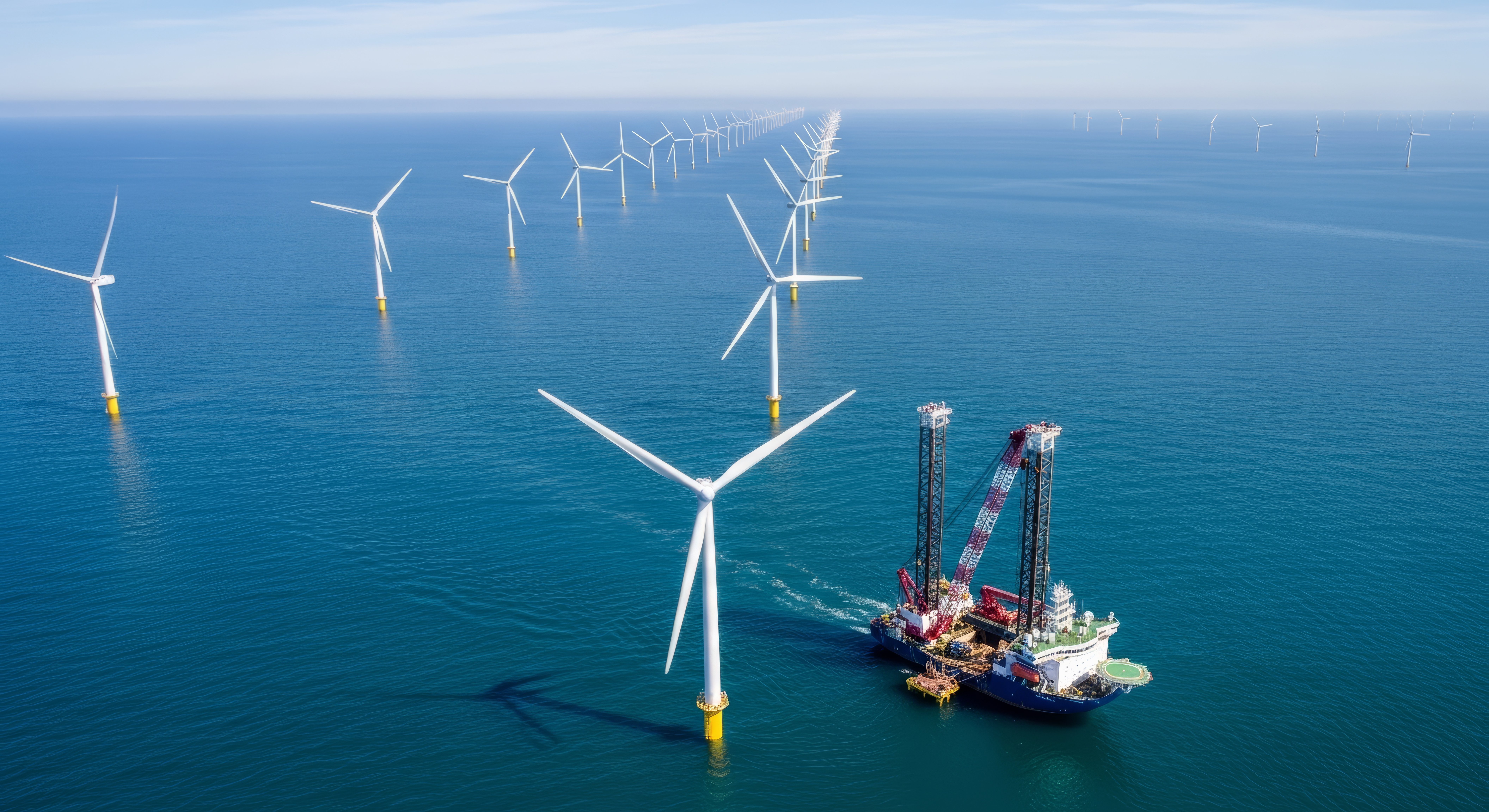
Capacity targets and auction results still make headlines across Asia-Pacific's offshore wind market, but they no longer tell the most important part of the story. Flagship projects across Taiwan, Japan, and South Korea offer a clearer view of what scaling the market involves in practice, from supply chains and technical workforce depth to commissioning, operations, and long-term asset performance.
That is where the conversation is shifting.
The question is no longer whether offshore wind can work in Asia. It already does.
The real test now is whether supply chains, technical workforce capability, and operating models can keep up with project ambition.

Taiwan's track record is substantial. Ørsted's 900 MW Greater Changhua 1 and 2a entered operation in 2024 as the largest offshore wind complex in Asia-Pacific. Yunlin at 640 MW followed. Greater Changhua 2b and 4 achieved first power in 2025, with its long-term power purchase agreement with TSMC marking a structural shift: offshore wind in Asia is no longer just a policy instrument. It has made a direct impact on corporate energy security and decarbonisation strategy. This compelling demand does not move with political cycles.

Against Taiwan’s target of tendering 15 GW of offshore wind capacity between 2026 and 2035, the conversation shifts to replicating delivery quality as conditions become more demanding.
It’s not just in Taiwan or in one country, but the entire region, largely due to constantly changing regulations which causes a domino effect across the Final Investment Decision (FID) and post-FID stages of offshore wind lifecycle. Any change in policies can push back the financial close or securing funding. EPCs may resort to aggressive bidding which can bring down the value of the supply chain. Delayed finance close shortens project execution timelines. This means that offshore projects don’t only need to operate on tighter budgets but need to deliver in significantly reduced timeframes.
Tighter financing, stricter localisation requirements, more complex supply chains, and multiple construction windows running simultaneously across the region are testing the limits of current best practices across the value chain.
In the immediate future, the projects that will matter most going forward are not the ones that win seabed rights. They are the ones that still deliver on time and to standard when those pressures compound.
Copenhagen Infrastructure Partners' Changfang and Xidao farms, at roughly 600 MW completed in 2024, set a new benchmark in the history of Taiwan's offshore wind programme in terms of the involvement of local suppliers and vendors.
For example, jacket foundations from Century Wind Power and a broad domestic supplier network turned the project into a proof point for what localisation can achieve when the execution model is built around it from the start.
The more important implication is how localisation reshapes offshore wind project execution models themselves. It brings in more suppliers, more handoffs, and more potential loopholes where quality can slip if the delivery structure is not solid enough. This leads to a greater demand for multi-party inspection, supplier qualification, and technical coordination across borders.
This is especially important as industry analysis estimates that more than two-thirds of Asia-Pacific’s total offshore wind investments will be allocated to local resources and services. However, these opportunities can only be fully realised if quality control, supplier oversight, and technical coordination increase in parallel.
The supply chain for this market is also increasingly regional rather than national. Korean cable-lay expertise is deployed to Taiwanese waters. Crew transfer vessels enter markets from other regional shipbuilding centres. Managing this interconnected ecosystem without compromising on quality or schedule is the real localisation challenge facing developers and their partners today.

Japan's Goto floating offshore wind farm reached commercial operation in January 2026, making it the first commercial floating project in Asia. At 16.8 MW, it is still small by regional standards, but that is not really the point. Goto demonstrates that floating wind in Asia is past the pilot stage and into commercial delivery, using structures and project frameworks adapted to local conditions.
South Korea's Ulsan cluster takes this argument further. The roughly 6.2 GW floating complex being advanced at Ulsan is not a technology experiment. It is an attempt to industrialise floating wind, backed by domestic shipyards, heavy industry, and coordinated government support. Tow-out operations, dynamic mooring installation, deep-water cable work, and compressed marine logistics all require specialist capabilities that fixed-bottom project experience may not fully cover. Ulsan’s success will depend on whether that expertise can be brought in early enough, and practically enough, to support delivery.

The common denominator affecting all markets is workforce. Global estimates point to a shortfall of several hundred thousand wind technicians by 2030 as a 50% demand increase looms in the next five years, while supply can take up to a decade to catch up. For offshore wind, where technical competency requirements and safety standards are significantly higher than onshore, the gap is sharper. Asia Pacific, expected to account for the bulk of new wind additions over this period, faces the steepest ramp-up of all.
The gap is not just about headcount. Offshore wind projects need highly skilled teams who understand the work, the safety environment, and the pace at which project phases shift.
Generic hiring and headhunting practices are not enough to support Asia’s offshore wind workforce demands, underscoring the need for targeted and specialised renewables recruitment.
This is also where Taylor Hopkinson, powered by Brunel, brings a distinct capability. As a trusted renewables recruitment leader with an established network of more than 19,000 technical professionals across Asia and beyond, Taylor Hopkinson works with developers, contractors, and asset owners to place engineers, project managers, and specialists who execute critical aspects of offshore wind projects. From development and construction through to commissioning and long-term operations, the focus is on matching the right technical expertise to the right project at the right time.

Taylor Hopkinson's regional presence supports Asia Pacific’s offshore wind localisation. With offices across the region, Taylor Hopkinson provides access to specialists who can support domestic supplier development, QA/QC programmes, and knowledge transfer between international teams and local workforces. After recruitment, mobilising talent compliantly across Asian markets is where Brunel's global mobility capability then takes over, managing international deployment logistics which projects depend on when specialist roles cannot be filled locally.
The offshore wind workforce market is extremely competitive in Asia and the increasing preference for local talents adds another layer of challenge. This underscores the importance of not just partnering with a recruiter, but a strategic and end-to-end workforce solutions and management partner. In reality, Asia’s offshore workforce is an emerging one and a deep understanding of the offshore lifecycle allows offshore wind-specialsed recruiters to provide consultative input on when local talents will work best and when expats with transferrable knowledge can be leveraged
Natasha Wu
Regional Business Development Director
Natasha adds, "She adds, “Over the last 17 years, Taylor Hopkinson has gained institutional knowledge in the renewables sector including offshore wind and have had great successes with a collaborative approach to our recruitment methodologies tailored to the specific needs of each project. At the end of the day, no offshore wind project is 100% alike so recruitment strategies need to adapt with them.”

Construction tends to get the attention. But the long-term commercial case for offshore wind is tested in operations. With roughly 4.3 GW already installed and operating in Taiwan and approximately 200 MW already past original warranty periods, O&M is no longer a future planning consideration, but a present requirement growing month by month as each new project crosses into its operating phase.
At a networking session hosted jointly by Brunel, Taiwan's Industrial Technology Research Institute (ITRI) and Asia Wind Energy Association (AWEA) late last year, Joey Yang (Project Director, ITRI) shared the conditions that make the Asia-Pacific O&M materially different from European precedent: typhoon-driven weather windows, high sand and salt concentrations, accelerated corrosion rates, and marine sediment movement affecting subsea cable integrity. Data shared from Taiwan's operating fleet showed corrosion accounting for 34.5 percent of failure types while pitch system faults account for 31 percent. The message from both organisations was consistent: European maintenance strategies were not designed for the unique Asia-Pacific conditions and cannot simply be exactly replicated.

Developers who build their O&M workforce strategies early, adapt to regional conditions, gain the support of partners with specialised technical staffing capability, will sustain operability. Those who treat O&M staffing as a procurement afterthought after construction has been completed will find that the gap between their target yield and the actual output harder to close than their business cases assumed.
There’s now zero doubt whether large scale offshore wind delivery is possible in Asia Pacific. The question now is how consistently projects can be built, staffed, commissioned, and operated as the market becomes more complex.
That is where the next phase will be won or lost.
For companies active in this space, the practical priorities are becoming clearer: stronger technical workforce planning, more disciplined localisation, and delivery models that hold up under real regional conditions. These are also the areas where Brunel and Taylor Hopkinson have a strong track record in supporting offshore wind projects across Asia Pacific.
Click here to schedule a discovery call with our team

1. Why are flagship offshore wind projects in Asia important now?
They prove that large‑scale offshore wind can be built and operated in the region, not just planned. The focus has shifted from “can it work?” to “can it be delivered on time and to standard under tight schedules and financing.”
2. How does localisation change offshore wind project delivery?
Localisation pulls in more domestic suppliers and services, which increases handoffs and quality‑risk points if not managed well. Strong technical coordination, supplier oversight, and multi‑party inspection are now critical to keep projects on track.
3. What is the real challenge with offshore‑ready technicians in Asia?
There is a growing gap in people with the right offshore skills and safety awareness, not just general construction workers. Generic hiring and last‑minute recruitment can delay projects and raise safety and quality risks.
4. How can companies make sure their offshore wind projects stay on schedule?
Early workforce planning, stricter supplier qualification, and robust QA/QC processes help projects hold up when construction windows and financing are tight. Working with partners that have deep regional offshore experience also reduces execution risk.
5. How can a specialist recruiter like Taylor Hopkinson help Asia’s offshore wind projects?
Taylor Hopkinson, supported by Brunel’s mobility network, helps developers and contractors find engineers, project managers, and technical specialists who can meet the specific demands of offshore wind. They focus on matching the right offshore‑ready talent to the right project phase, which can support safer, and more reliable delivery.