
Concentrated Solar Power (CSP), Explained
23 May 2022
renewable energy
renewable energy
Learn more about what concentrated solar power is, including how it works, how it’s used, its advantages and drawbacks and how it differs from solar PV.
- What is concentrated solar power (CSP)?
- How does CSP work?
- What are the advantages and disadvantages of CSP?
- How efficient is CSP?
- Where is CSP used?
- What is the difference between solar PV and CSP?
- What are some environmental impacts of CSP?
- What does the future hold for CSP?
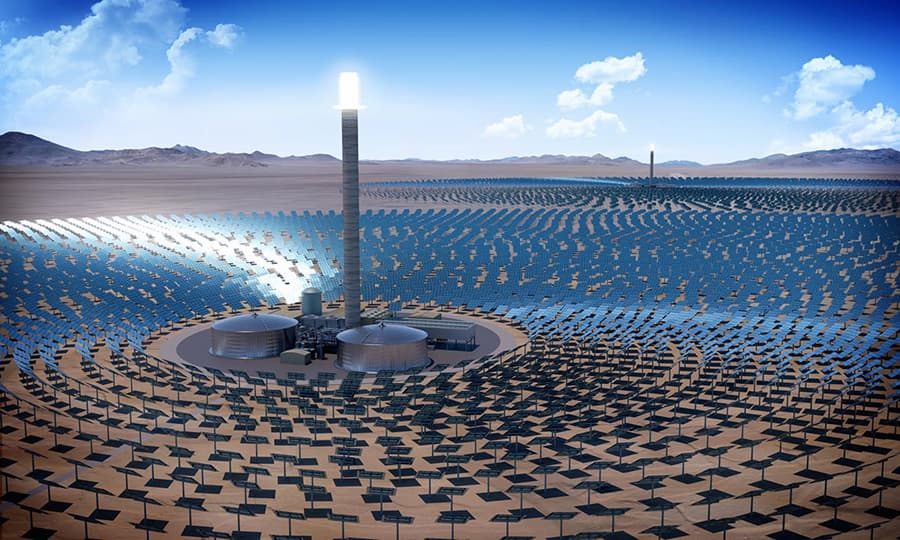
Concentrated solar power (CSP) is an approach to generating electricity through mirrors. The mirrors reflect, concentrate and focus natural sunlight onto a specific point, which is then converted into heat. The heat is then used to create steam, which drives a turbine to generate electrical power. The process can be repeated continuously because CSP technology can store the heat produced. It can therefore be used on days where there is no sun, or before sunrise and after sunset.
According to the International Energy Agency (IEA), CSP generation increased by an estimated 34% in 2019. Although this exponential growth is impressive, there’s still some way to go until CSP reaches its Sustainable Development Goals (SDGs), which requires an average growth of 24% through 2030.
CSP technologies use a mirror configuration that concentrates the sun’s solar energy onto a receiver, which converts it to heat. The heat is then converted into steam to drive a turbine that produces electrical power. CSP plants can use thermal energy storage systems to store the power until it’s needed, for example during periods of minimal sunlight. The ability to store energy is what makes CSP a flexible source of renewable energy.
CSP systems can also be combined with other power sources to create hybrid power plants. For example, CSP can be integrated with thermal-fired power plants that use fuels like coal, natural gas and biofuel.
There are four types of CSP technologies:
Here’s a video overview from New Physicist that demonstrates how concentrated solar power works:
Perhaps the most obvious advantage of CSP is that it’s renewable. Its supply will never be exhausted and be can used continually, so it’s a sustainable energy source. It also reduces carbon footprint. Unlike fossil fuels, which emit carbon dioxide when burned, CSP uses the earth’s natural resources, which is kinder to the environment. It can improve the quality of air and reduce the rate of climate change.
CSP also provides a relatively continuous source of electricity, particularly in comparison to solar photovoltaics (PV) and wind power, which provide intermittent supplies. Because CSP plants can store solar energy in the form of molten salts, the electricity generated is predictable and reliable.
CSP can be easily integrated into existing steam-based power plants. Even those running on fossil fuels can be used for CSP systems. The operating cost of a CSP plant is also lower than nuclear and hydrocarbon-based plants because the operations and maintenance is simpler.
Concentrated solar power can be used in combination with other energy sources, providing a more secure energy grid. When used in the energy mix, CSP can help meet future electricity demand. It can also aid oil recovery as the steam it produces can be used to concentrate heavy oil so it’s easier to pump.
It also has potential to be used as a transportable form of energy. For example, renewable energy consultancy Ecofys published a study to assess the feasibility of CSP being used as a technology to produce cost-effective hydrogen that could act as an energy carrier to power transportation.
Despite the many benefits of CSP, it does have its downsides. For one, it’s largely dependent on location. Similar to solar PV and wind power, CSP plants require a large area of land to operate, which makes it uneconomical in populated areas.
Concentrated solar power uses a lot of water to drive steam turbines and to cool thermochemical reactors. Although seawater may be seen as a possible solution, this could present solar radiation issues for the surrounding landscape. Similarly, CSP plants can attract animals with its light, and the heat can be fatal for some species.
CSP plants are also expensive to run. Thermal energy storage materials that can withstand high temperatures are costly and difficult to source. Molten salt, for example, has a limited operating range because it solidifies at low temperatures and decomposes at high temperatures.
Competition from other energy sources like solar PV and fission-based nuclear power means that CSP doesn’t always receive the development it needs to become a primary energy source. As breakthroughs continue in other areas, concentrated solar power runs the risk of becoming obsolete.

Above: Gemasolar Solar Plant, a small-scale CSP project located in the Seville province of Spain
The efficiency of a CSP system varies depending on several factors. The type of system, the engine and the receiver all make a difference to how efficient a concentrated solar power system will run. However, according to a statistic cited by EnergySage, most CSP systems have an efficiency of between 7 and 25%.
To provide some context, hydropower systems can achieve up to 90% efficiency and wind turbines can achieve efficiencies of up to 59%. Solar PV efficiencies are similar to concentrated solar power systems with most photovoltaic panels achieving an efficiency of between 14 and 23%.
According to online publication, NS Energy, global CSP installations grew at a rate of 24% from 765MW in 2009 to 5.4GW in 2018.
Most of the world’s CSP plants are in Spain, accounting for over 42% of all CSP installations worldwide. The Planta Solar 10 (PS10) in Spain was the first commercial utility-scale solar power tower in the world. The country plans to double its CSP capacity by 2025, to 4.8GW as part of a ten-year energy plan.
Morocco currently has the largest CSP project in the world - the Ouarzazate Solar Power Station, which has a capacity of 510MW. It comprises three plants in total and started operating in 2016, using parabolic trough technology. It provides power consumption to around 1.1. million Moroccans.
However, the Moroccan plant is due to lose its rank to Noor Energy 1, Dubai’s 700MW CSP project, which is currently under construction. The plant, which will use a combination of parabolic trough and solar tower technologies, doesn’t have a completion date, but is part of the Dubai government’s ‘Vision 2021’ initiative to ensure sustainable and environmentally friendly development.
The USA is also known for its CSP projects and currently has 52 plants, the largest being the 392MW Ivanpah facility in California. However, there haven’t been any new CSP projects in the USA since 2016.
Perhaps the biggest difference between solar PV and CSP is the way in which electric power is produced. CSP systems convert the sun’s energy using various mirror configurations that drive a heat engine and produce electrical power.
Photovoltaic solar panels, on the other hand, use the sun’s light, rather than its energy. Unlike CSP, PV converts light into electricity directly. The solar PV cells absorb light (rather than reflect heat), which stimulates electrons that create a current. The direct current (DC) is captured and converted into an alternating current (AC) using inverters so it can be distributed on the power network.
CSP systems store energy through Thermal Energy Storage technologies (TES), so power can be used when there isn’t enough sunlight. PV systems, however can’t store thermal energy because they use direct sunlight, rather than heat. For this reason, CSP systems are better for energy storage and efficiency.

Above: a CSP Solar Trough Collector utilized to generate solar power
Because CSP plants require a lot of space, they’re often situated in arid, or ‘sun belt’ regions, where access to fresh water is scarce. Wet cooling towers are required for cooling the thermal cycle and water is also needed to clean the mirrors to maintain their reflectivity. The prospect of using large amounts of fresh water in these areas is often criticised, especially when water demand in the Middle East and North Africa is on the rise.
Another environmental impact of CSP plants is the visual impact they have on areas. A common environmental criticism is that CSP plants disturb the views of natural landscapes far more than other energy sources like wind power plants.
Despite the lack of agriculture in sun belt regions, they still have environmental value and provide habitats for threatened species. The arid nature of these regions also means that it takes longer for the landscape and community to recover from the effects of disturbance. For example, animal populations can be affected by the infrastructure that’s required to operate a CSP plant.
CSP plants use more materials than conventional fossil-fired plants, many of which aren’t recyclable. Concentrated solar power plants also produce toxic substances like biphenyl, which when burnt at high temperatures, can produce dioxins that stay in the environment for many years and can be harmful to humans.
Greenhouse gas emissions are linked to CSP plants as the nitrous salts used in energy storage emit nitrous oxide (N20), which damages the ozone layer.
Concentrated solar plants can also have a negative impact on flora and fauna. For example, traffic routes and building works can disturb the surrounding ecosystem and cause mortalities to local fauna.
While the global solar industry has experienced rapid growth over the past decade, the emergence of concentrated solar power has had quite an impact. According to Solar Spaces, there are over 130 CSP projects globally, with a total installed capacity of 5,500 MW.
While CSP tariffs are lower than ever before, there are still several challenges facing concentrated solar power. For one, CSP plants are expensive to establish, operational costs are high and there’s a lack of funding available to finance new projects. However, once the CSP supply chain improves and investors start to see the opportunities in CSP, research will help drive down costs and the future will start to look brighter for concentrated solar power.
In terms of technological development, research is underway to explore how CSP can make fuel out of air and light. According to the IEA, by the end of the century, CO2 will need to be removed for the air to keep global temperatures below two degrees. Concentrated solar power looks set to play a key role in assisting with the removal of carbon dioxide.
Researchers at the US Department of Energy’s Oak Ridge National Laboratory (ORNL) are researching how CO2 can be captured from air and removed using amino acid chemistry.
Similarly, direct air capture company, Climeworks have developed carbon removal technology that can capture atmospheric carbon with a filter, using low-grade heat as an energy source.
Here’s a video overview of how the technology works:
At Brunel, we understand that to be successful a strategic and sensible approach is required. Identifying a partner who knows what they’re doing and already has candidates in hand; a partner who is highly experienced in technical recruitment and understands technical education and transferable skills.
As the renewable industry races forward, the recruitment industry needs to go back to its roots, back to traditional recruitment to source the right candidates. Knowing candidates personally and having regular interaction and contact is more important than ever.
We’ve been immensely successful in supporting the renewables industry because we know our candidates. We take raw talent, or experienced experts with transferable skills, and guide them on a new path to success.
With many happy candidates and clients identified and matched we’re doing our part toward creating a cleaner and greener world.