How the Hydrogen Grand Prix is inspiring students to engineer the future
02 September 2026
renewable energy
renewable energy
Getting more young women interested in engineering and STEM is not simply a matter of teaching the theory. Sometimes, the most powerful way to spark that interest is to give students a problem they can physically build, test, break, rethink and improve.
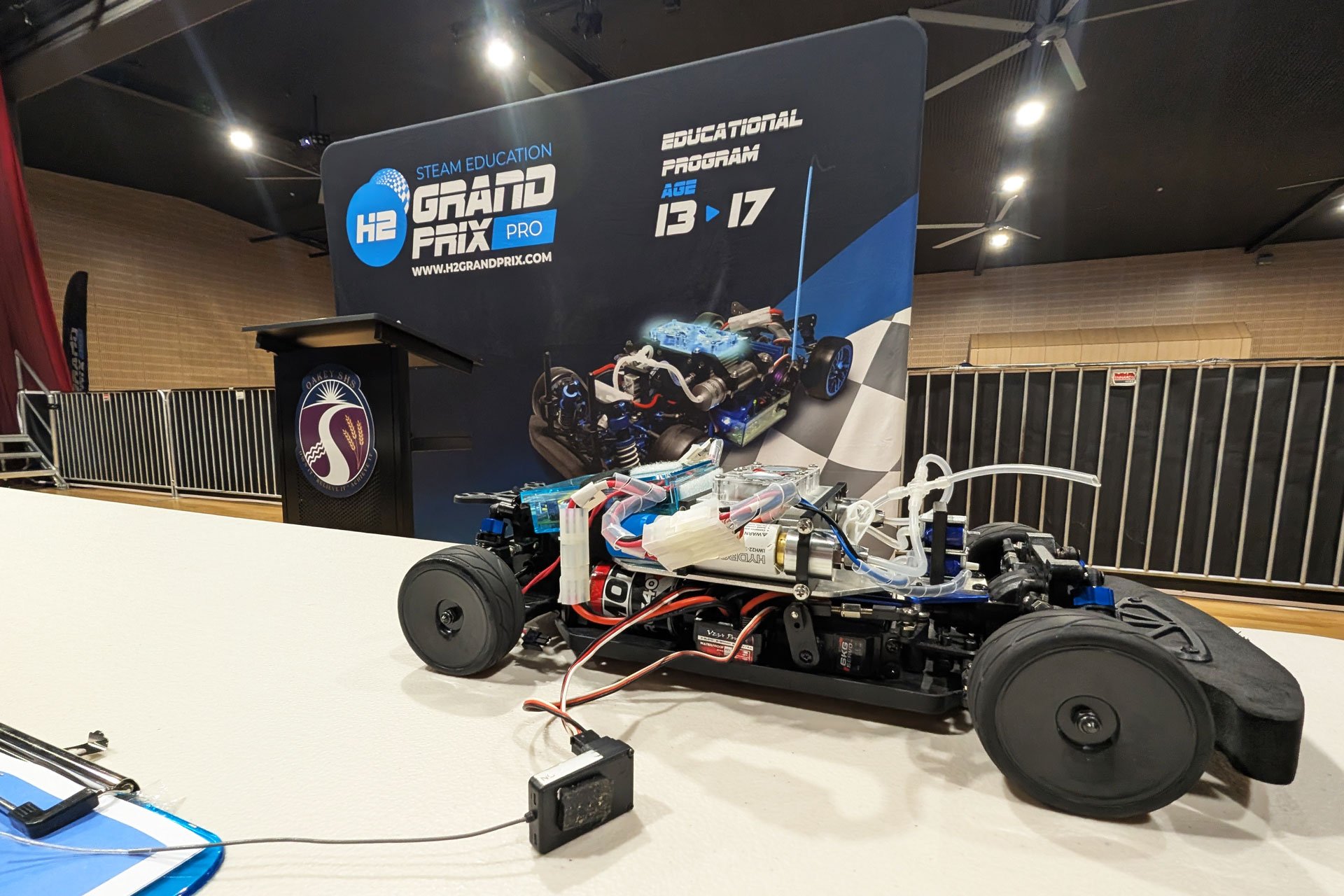
At Fairholme College, the Hydrogen Grand Prix (H2GP) has provided exactly that opportunity. For the past three years, Brunel has proudly sponsored Fairholme College’s participation in the H2GP; a STEM education program which challenges students to design, build, optimise and race hydrogen-powered remote-controlled cars.
The program culminates in a series of 4-hour races which test the efficiency and endurance of each team’s vehicle, along with the resilience and collaboration skills of the students themselves. While these races provide plenty of exciting real-time thrills and spills, it’s easy to forget that the race is merely the capstone of a much larger learning journey.
While hydrogen energy experiments form part of classroom learning, participation in the H2GP team is entirely extra-curricular. But the interest and passion was there to keep drawing students back for afterschool and lunchtime sessions each week.


Each H2GP car is powered by a hydrogen fuel cell. Hydrogen stored onboard the vehicle is fed into the fuel cell, where it reacts with oxygen to generate electricity. That electricity powers an electric motor, with water produced as the by-product.
For students, that means concepts such as energy generation, electricity, battery technology and hydrogen are no longer confined to a textbook or science experiment. They can see those principles working together to propel a vehicle around a racetrack – and quickly discover that making them work efficiently is an engineering challenge in itself.
Teams start out with a relatively standard vehicle using the parts provided in their kit, focusing on developing rudimentary energy conservation and racing strategies. But there are far more layers to explore beyond these basics. Students can adjust almost every aspect of the vehicle: reducing weight, changing components, redesigning internal layouts, improving pit-stop changeovers and optimising the relationship between speed, reliability and energy consumption.
It is this ability to keep digging deeper into these technical challenges that has helped make the program particularly effective at Fairholme.
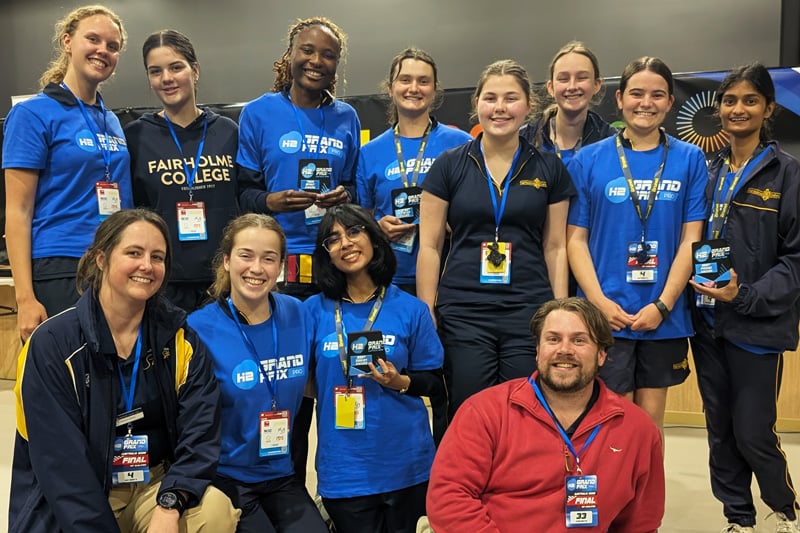
Fairholme College’s competition debut in 2024 couldn’t have been much bigger. As Australia’s top all-female crew, they qualified and competed in the H2GP world finals in Anaheim, California. They ultimately placed 13th in a field of the world’s top 28 teams far exceeding everyone’s expectations and creating a surge of interest within school.
Buoyed by this success, Fairholme returned in 2025 with a second H2GP team. New students, new ideas and strong results followed, qualifying for the world finals once more while also claiming Fastest Pitstop and Team Spirit awards.
By 2026, Fairholme’s H2GP program had homed in on three core areas: fabrication and modification, race and pit strategy, and coding. Students have worked with soldering and circuitry, 3D printing, carbon fibre, chassis design and software. They have experimented with softer wheels for additional grip, lowered the chassis to improve stability and handling, adjusted the drivetrain and reorganised wiring to improve safety and reliability. Custom 3D-printed battery and hydrogen storage mounts have also been designed to keep components secure while enabling faster changes during pit stops.
As Fairholme’s students have become more experienced, software and data have become increasingly important to their performance. Coding allows the teams to adjust how their cars accelerate and consume energy, helping them find a balance between speed and endurance. During racing, telemetry provides another layer of information, with pit crews able to monitor metrics including motor and fuel-cell current and use that data to guide decisions on track.
Students have to interpret information, identify patterns and communicate with drivers to determine when to push and when to conserve energy. They can compare performance between drivers and use evidence rather than instinct to refine their strategy. It creates a miniature engineering environment in which mechanical design, electrical systems, software, data analysis and human decision-making all need to work together.


One of the most significant developments at Fairholme throughout their H2GP journey has been the transition towards student-led innovation.
Rather than simply being shown how to modify their cars, students increasingly generate their own ideas and determine how those ideas can be implemented and tested. The teaching role has consequently evolved towards facilitation, with students and teachers sometimes learning new technical skills – particularly coding – alongside one another.

Perhaps the strongest measure of Fairholme College’s H2GP program is what has happened beyond the racetrack.
Following a successful debut in 2024, interest among students grew sufficiently for Fairholme to expand its participation to two H2GP teams. The College also introduced a dedicated Engineering subject in response to growing student enthusiasm.
There are also signs that this engagement is translating into longer-term career choices too. Several former Fairholme H2GP participants have subsequently enrolled in engineering degrees, while one graduate has gone on to work with H2GP competition coordinator Horizon Educational in a student outreach role.
For an all-girls school, those outcomes demonstrate what can happen when young women are given an environment in which engineering is something they actively do rather than simply a career they hear about.


The success of the H2GP at Fairholme demonstrates the value of giving female students the opportunity to experience STEM rather than simply learn about it.
A hydrogen-powered model car might be the starting point, but following the challenge far enough introduces students to mechanical and electrical engineering, renewable energy, software development, data analysis, advanced manufacturing and materials science – alongside teamwork, communication and project management.
Most importantly, there is no single correct answer. Students are encouraged to ask what could work better, develop their own solution and then find out whether the evidence supports it.
For Brunel, supporting Fairholme College’s participation in the Hydrogen Grand Prix is an investment in precisely that kind of curiosity. As industries around the world seek the engineering and technical skills needed to deliver new energy technologies, advanced infrastructure and increasingly complex projects, encouraging more young women to see themselves as engineers is an important part of building the future workforce.
Fairholme’s students may start out wanting to race a car. But along the way, they are learning how to think, collaborate and innovate like engineers – and for some, that experience is already helping turn an interest in STEM into a future career.

For over 25 years, Brunel has worked with innovators and leaders from Australia's resource and power generation industries to deliver both small and large-scale projects. Speak with our renewable energy experts today and discover how Brunel can help meet your personnel and project needs.